
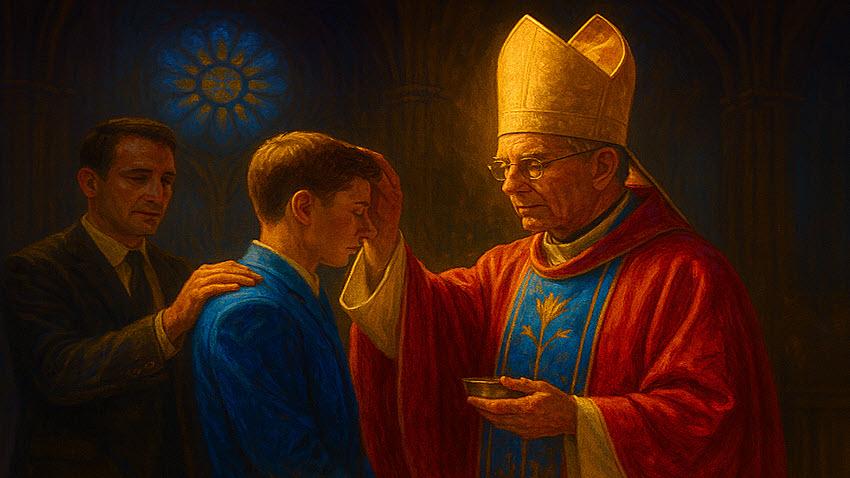
Let’s check if confirmation is found in the teachings of Christ and the apostles.
Is it a sacrament or a human addition?
Do we have a description of such a ceremony in the Scriptures?
Let’s see.
What is confirmation?
Confirmation is a sacrament which, according to the teachings of the Church, is intended to:
• strengthen the believer with the Holy Spirit,
• give the „fullness of baptismal grace,”
• make him or her a „mature Christian,”
• more fully integrate him or her into the Church.
It was formerly called the „sacrament of Christian maturity.”
How is it performed?
• It is usually administered by a bishop,
• through anointing with chrism (oil),
• and by the laying on of hands,
• while saying the formula: „Receive the seal of the gift of the Holy Spirit.”
The Catechism teaches that confirmation:
• „deepens the grace of baptism” (CCC 1285),
• „imprints a spiritual mark on the soul” (CCC 1304),
• „confers the fullness of the Holy Spirit” (CCC 1288),
• is one of the seven sacraments.
The Church connects this with events from the Acts of the Apostles, where the apostles laid hands on new believers so that they might receive the Holy Spirit.
What does the Bible say about confirmation?
This question arises very often because the Catholic Church teaches that confirmation is a sacrament that „completes baptism” and „strengthens the believer with the Holy Spirit.” However, when we look at the New Covenant (New Testament), it turns out that Scripture does not know of any sacrament of confirmation in this form.
In the Bible, there is the receiving of the Holy Spirit, and this happens:
• after receiving the gift of faith,
• sometimes through the laying on of hands by the apostles,
• sometimes without the laying on of hands,
• without oil and the sign of the cross.
Let’s look at the verses that the Catholic Church interprets as the basis for confirmation.
1. Acts 8:14–17:
“When the apostles in Jerusalem heard that Samaria had accepted the word of God, they sent Peter and John to them. When they arrived, they prayed for them that they might receive the Holy Spirit. Then they placed their hands on them, and they received the Holy Spirit.”
This is the closest to confirmation. We only see that the newly converted receive the Holy Spirit immediately after believing.
2. Acts 19:5–6:
“When they heard this, they were immersed in the name of the Lord Yeshu. And when Paul placed his hands on them, the Holy Spirit came on them, and they spoke in tongues and prophesied.”
Here we have the filling with the Holy Spirit. Through this, we see three elements:
• faith,
• baptism/immersion,
• the immediate gift of the Holy Spirit.
3. Acts 10:44–48:
“While Peter was still speaking these words, the Holy Spirit came down on all who heard the message.”
Here, the Holy Spirit descends without the laying on of hands, without any ceremony. God himself gives the Spirit to everyone who believes in the name of Yeshu.
4. Acts 2:1–4:
“When the day of Pentecost came, they were all together in one place. Suddenly a sound like the blowing of a violent wind came from heaven and filled the whole house where they were sitting. They saw what seemed to be tongues of fire that separated and came to rest on each of them. All of them were filled with the Holy Spirit and began to speak in other tongues as the Spirit enabled them.”
It is the feast of Pentecost. The Holy Spirit descends upon the believers.
5. Galatians 3:2:
“Did you receive the Spirit by observing the law, or by believing what you heard?”
Paul says: The Holy Spirit comes through faith.
6. Romans 8:9:
“If anyone does not have the Spirit of Christ, they do not belong to Him.”
The Holy Spirit is a sign of belonging to the Lord Yeshu.
7. Ephesians 1:13
“In Him you also, when you heard the word of truth, were sealed with the promised Holy Spirit.”
This did not happen through oil, or through a sacrament – but through faith.
What does this mean?
The Bible teaches that:
• The Holy Spirit comes upon believers through faith,
• sometimes during the laying on of hands,
• sometimes without any touch,
• sometimes before baptism/immersion, sometimes after baptism/immersion,
• always in the name of Yeshu.
There is no sacrament of confirmation in the Bible as understood today: there is no oil, no sign of the cross, no ceremony for young people, no false names of Christ: Jesus or other false names, no images or other representations through which people pray to God.
The New Testament shows one consistent path:
Belief in the true Christ and in His true name → baptism/immersion → receiving the Holy Spirit.
Who can impart the Holy Spirit?
He who possesses the gift of the Holy Spirit is one who serves God according to His commandments.
Now, reader, all you need to do is examine your religion to see if it operates according to the commandments, whether it belongs to God or to some other deity.
How to do this?
Answer these basic questions for yourself.
1. Does your religion use images?
Images and depictions of Christ, God, or people are forbidden in this faith. It is not permitted to bow before an image or to pray to it. The same applies to other relics: crosses, medallions, rosaries, etc.
2. Does your religion involve the name jesus?
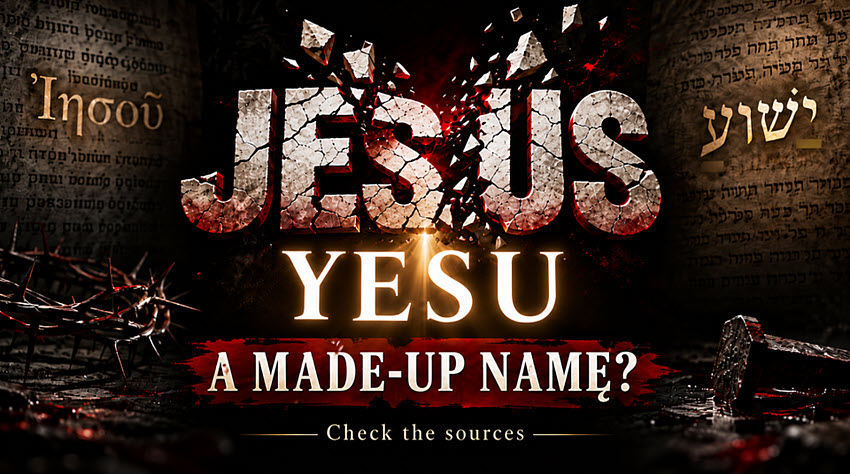
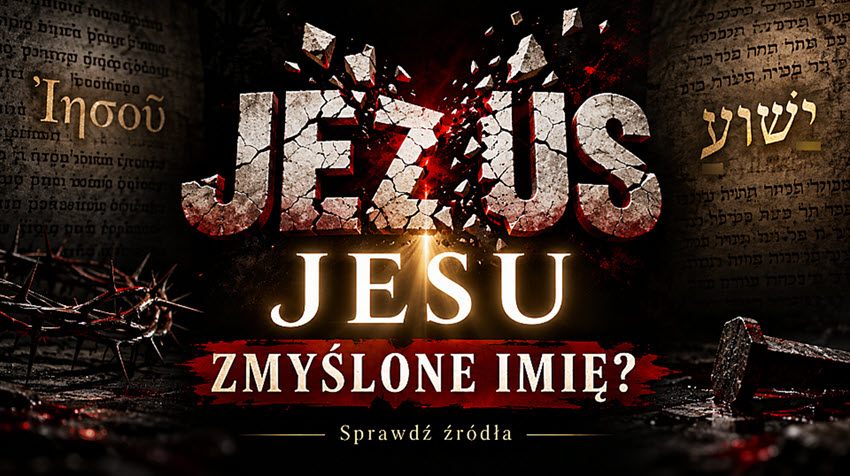
Christ’s name was not Jesus, or Yeshua in Hebrew, Aramaic, or Greek. These are names invented by translators or falsifiers of the Scriptures. The Hebrew and Aramaic name is Yeshu. The Greek name is Yesu.
3. Does your religion include the cult of the virgin Mary – the veneration of Mary?
Mary/Miriam was a wonderful woman, since she received the honor of giving birth to and raising Christ. That was her task, and she fulfilled it very well.
The task was completed, and on the day of his death, Christ instructed His disciple to take care of Mary/Miriam.
This is Miriam’s only role in the Scriptures. She is not an intermediary between God and people, and it is not permissible to pray to her, or to any apostle or saint.
Why?
Because there are no such teachings in the Biblical Scriptures.
4. Does your religion involve the trinity?
If your religion says that the Father and the Son are the same Person or Being, then that is an incredible lie.
“But even in your Law it is written that the testimony of two men is valid. I bear witness about Myself, and the Father who sent Me also bears witness about Me.” Then they said to Him, “Where is your Father?” Yeshu answered, “You know neither Me nor My Father. If you had known Me, you would have known My Father also.” – John 8:17-19.
“…I am going to the Father, for the Father is greater than I.” – John 14:28.
Please check the basic principles of the faith:
The Basics of Faith: Do You Believe It? – Part 1
Basics of Faith: Do You Believe in the Name of Christ? – Part 2












Zapraszam do komentowania, wyrażania swojej opinii: