
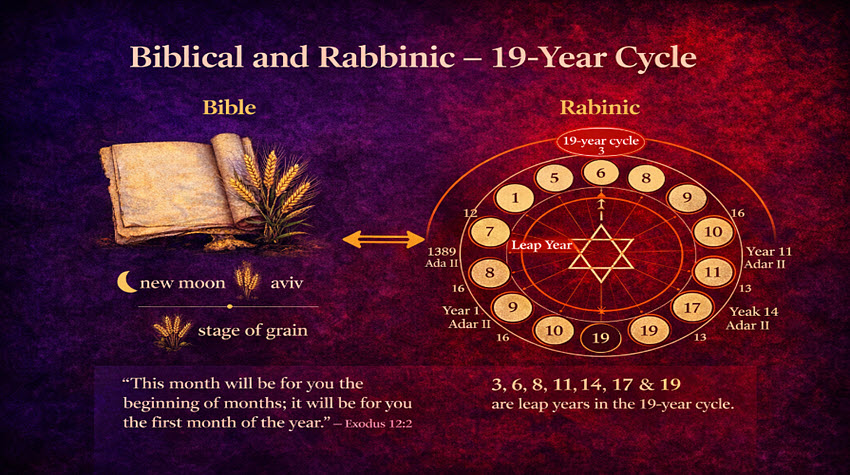
4 – God gave Israel the lunar calendar
4.1 – The basis of the lunar calendar are the signs in the sky:
„Let there be lights in the firmament of the heavens… for signs, seasons, days, and years” – Genesis 1:14.
4.2 The beginning of the year is the month of AWIW:
„This month shall be for you the beginning of months, the first month of the year” – Exodus 12:2
„Today you go out, in the month of Aviv” – Exodus 13:4.
4.3 The year begins in spring when:
• Barley is in a state of aviv (not ripe but formed),
• It can be used to make firstfruits (the first, earliest harvest given to YHWH).
4.4 Months are determined by the moon:
„He made the moon to mark times” – Psalm 104:19.
Each month:
• begins with a new moon,
• lasts 29-30 days,
• is counted from evening to evening.
A „lunar” year (counted solely by lunar months) lasts approximately 354 days: that’s 12 months of approximately 29.53 days each.
5 – Leap year – 19-year Jewish cycle
Let’s see if we should add one month, that is, distinguish leap years. In that case, the Memorial should take place one month later.
Rabbinic Judaism follows a fixed 19-year calendar cycle. This is the so-called Metonic cycle: 19 years ≈ 235 lunar months. Within this 19-year cycle, leap years are: 3, 6, 8, 11, 14, 17, and 19. In a leap year, they add an extra month before Adar: this added month is usually called Adar I, while the „normal” Adar in a leap year is sometimes called Adar II. They calculated this by taking the year number (in their calculation) and calculating the remainder when dividing it by 19.
Let’s take an example.
According to jewish calculation, the year is now 5786.
• 5786 ÷ 19 has a remainder of 10, so it’s not a leap year (there’s only one Adar).
Let’s do the detailed calculations for the next year: 5787.
Step 1: Divide the year by 19 and take the remainder:
• 5787 ÷ 19 = 304 and the remainder is 11 (this remainder is because 19×304 = 5776, and 5787−5776 = 11).
Step 2: Check if the remainder is „leap”:
The leap years in the cycle are: 3, 6, 8, 11, 14, 17, 19 (and the remainder 0 means „year 19”).
Since the remainder is 11, 5787 is a leap year (it has 13 months).
Then they add an extra month, Adar: Adar I and Adar II appear (instead of one Adar). Leap year month schedule (in short):
Tishri, Heshvan, Kislev, Tevet, Shevat, Adar I, Adar II, Nisan, Iyar, Sivan, Tammuz, Av, Elul.
This fixed, 19-year cycle with seven „13-month” years originated around 358/359 AD – according to tradition, it was made public by Hillel II in the year 4119 AM (AM is an abbreviation for the Latin Anno Mundi – meaning „year of the world”).
Does this cycle apply to us when calculating the date of the Memorial?
Let’s consider the facts:
• The Bible does not divide leap years.
• The Bible does not mention the second Adar.
• In the Bible, the beginning of the year depends on the month of Aviv—the ripeness of the grain, not the numerical cycle.
• There is no verse where the Israelites added an extra month. In the spring, they waited for the barley, which should have been in the Aviv phase, meaning ready for the sheaf of firstfruits. The addition of an extra month was introduced much later in the 4th century (358/359 AD), and the rules were fully developed in the 10th century, around 922–924 AD.
For these reasons, we should not copy the beliefs of judaism, or the jews. They implemented their own rules for celebrating Passover for centuries. We are not interested in adding a thirteenth month, advancing the first of Aviv by a month, or a 19-year calendar cycle. These are not found in the Bible. If God had wanted to make such changes, He would have communicated them.
6 – How was 1 Aviv determined?
Step 1: The barley in the land of Israel was checked,
→ to see if it was in a state of aviv (ready for the sheaf of firstfruits—the first, earliest harvest given to YHWH).
Step 2: The new moon was observed,
→ to see if the moon was completely invisible.
Step 3: When the new moon appeared,
→ the 1st of Aviv was announced.
7 – When is the new moon? 0% or crescent?
Is it a new moon when the crescent moon is illuminated?
Is it a new moon when the entire moon is invisible?
7.1 The new moon was solemnly announced:
„At the beginning of your months/new moons (chôdesh, Strong’s H2320) you shall blow the trumpets over your burnt offerings” — Numbers 10:10.
„And on the day of the new moon/new moon (chôdesh, Strong’s H2320) you shall offer burnt offerings to YHWH” — Numbers 28:11.
So, on 1 Aviv:
• the beginning of the month was announced,
• the trumpets were blown publicly,
• sacrifices were offered to God.
7.2 The first crescent, i.e. the waxing crescent, is already the second phase of the moon.
In ancient times, the Israelites observed the moon. We can analyze and discuss whether the more obvious form of the new moon, visible to all, was the complete absence of the moon, or the emergence of the moon and the sight of an illuminated crescent.
It can be assumed that the absence of the moon was the most visible and obvious phase for all. Everyone could have observed this phenomenon.
However, seeing an illuminated crescent was not so obvious. One priest will say: „It’s already visible,” another: „Let’s wait a bit longer, because the crescent isn’t clearly visible.”
How do we determine the new moon today?
Today, we don’t observe the moon as the Israelites did. We don’t wait for the crops to appear. We try to calculate the most accurate date, which is the 14th of Aviv. We rely on websites that provide moon phases, percentages of moon phases, moonlight, and conjunctions.
Let’s move on to analyzing this topic.
We have the following moon phases:
| Moon Phase | % dial illumination |
|---|---|
| New Moon | 0% (basically ~0–1%) |
| The Waxing Crescent | 1–49% |
| First Quarter | 50% |
| The Waxing Gibbous | 51–99% |
| Full Moon | 100% (basically 99–100%) |
| The Waning Gibbous | 99–51% |
| Last (Third) Quarter | 50% |
| The Waning Crescent | 49–1% |
| Source: U.S. Naval Observatory — “Phases of the Moon and Percent of the Moon Illuminated” | |
Let’s consider this fact: a new moon is between zero and one percent, meaning the moon is invisible. When the moon emerges from an eclipse and a crescent is visible, we are already in the second phase of the moon, the waxing crescent.
Such conclusions are consistent with God’s creation. Let’s analyze this.
7.3 New and Full Moon
God creates the world in pairs and opposites:
• light ↔ darkness,
• day ↔ night,
• maximum ↔ minimum.
“Let there be lights in the firmament of the heavens for signs and appointed seasons” – Genesis 1:14.
The full moon is the maximum of light – 100%, unambiguous light.
The new moon is the opposite of the maximum, 0%, the unambiguous absence of moonlight.
If full moon = 100%, then new moon = 0%.
This is:
• logical,
• symmetrical,
• consistent with the order of creation.
God does not create things “more or less.” The full moon is not “almost full.” The new moon is not “almost new.”
These are the culminating points of the cycle, even if humans: do not measure them with a watch or do not know percentages.
God created the lunar cycle with two extremes:
• full moon (100%),
• new moon (0%).
The new moon, as the absence of light, is visible and obvious to all.
1 Aviv was announced at the time of the new moon, regardless of whether it lasted one or two nights.
Since God created the lunar cycle precisely, and the full moon is its maximum (100%), the new moon—as the opposite of full—is its minimum (0%); the absence of the moon is visible to all and sufficient to begin 1 Aviv.
The month of Aviv began at the turn of our calendar: March/April.
7.4 Conjunction, UTC time and actual moment of new moon – March 2026
We can see on websites that there are two moon exposure dates and one conjunction date. Some websites indicate that the new moon is on March 18th, but the conjunction is on March 19th:
|
Location (Country) |
Source |
Illumination 18.03 (local) |
Illumination 19.03 (local) |
Method of Calculation „%” |
Conjunction (local time) |
Conjunction (UTC) |
|---|---|---|---|---|---|---|
| Warsaw (Poland) | Timeanddate (monthly table) |
0,5% |
0,2% |
daily value („Illumination is calculated at lunar noon”) | 19.03.2026, 02:23 (CET) | 19.03.2026, 01:23 |
| Warsaw (Poland) | Metcheck |
0% |
0% |
daily value, highly rounded (may show „0%” for 2 days) | 19.03.2026, 02:23 (CET) | 19.03.2026, 01:23 (USNO) |
| Warsaw (Poland) | MoonGiant (18.03) / MoonGiant (19.03) |
0% |
1% |
daily value + rounding (for them „illumination” is not „in seconds”) | 19.03.2026, 02:23 (CET) | 19.03.2026, 01:23 (USNO) |
| Jerusalem (Israel) | Timeanddate (monthly table) |
0,6% |
0,2% |
daily value („Illumination is calculated at lunar noon”) | 19.03.2026, 03:23 (IST) | 19.03.2026, 01:23 |
| Jerusalem (Israel) | Metcheck |
0% |
0% |
daily value, heavily rounded | 19.03.2026, 03:23 (IST) | 19.03.2026, 01:23 (USNO) |
| Jerusalem (Israel) | MoonGiant (18.03) / MoonGiant (19.03) |
0% |
1% |
daily value + rounding | 19.03.2026, 03:23 (IST) | 19.03.2026, 01:23 (USNO) |
| New York (USA) | Timeanddate (monthly table) |
0,2% |
0,6% |
daily value („Illumination is calculated at lunar noon”) | 18.03.2026, 21:23 (EDT) | 19.03.2026, 01:23 |
The new moon is the moment of conjunction of the sun and moon, when the moon is completely invisible (0% illumination). In the Bible, the new moon is not explained mechanically; it is simply the moment when the moon ceases to be visible in the sky.
To maintain global precision, UTC (Coordinated Universal Time) is used to determine this moment—an international standard time based on atomic clocks, which provides a common reference point for the entire world, regardless of time zones.
The astronomical conjunction of the moon and sun occurs on March 19, 2026, at 01:23 UTC:
• USNO (U.S. Naval Observatory): 2026 Mar 19 01:23 (Universal Time).
• timeanddate (table of phases for UTC): Mar 19 01:23 (UTC).
At this time, the exact moment of the new moon is for all countries in the world. Now, we need to add/subtract time zones. After taking into account local time zones, the new moon is:
• Warsaw (CET = UTC+1): March 19, 2026, 2:23 AM.
• Jerusalem (IST = UTC+2): March 19, 2026, 3:23 AM.
• New York (EDT = UTC−4): March 18, 2026, 9:23 PM.
Why do we consider conjunctions, and not „0% illumination,” to determine new moons?
1) Conjunction is the definition of new moon (astronomy).
The U.S. Naval Observatory (USNO) defines the astronomical new moon as the moment when the sun and moon have the same geocentric ecliptic longitude. This is a single, unique moment (can be specified to the minute/second) – independent of location; only the notation varies across time zones.
Source of the definition (USNO): aa.usno.navy.mil/faq/moon_phases
also
aa.usno.navy.mil/faq/crescent.
2) „Illumination percentage” is not calculated at the moment of conjunction on many services.
For example, timeanddate in the monthly table states that „Illumination is calculated at lunar noon,” so these percentages are daily values, not „at the second of the new moon.” Therefore, you might see „0%” as early as March 18th, even though the exact new moon (conjunction) falls locally on March 19th (Warsaw/Jerusalem) – or still on March 18th in the evening (New York).
3) Rounding uses „0%” and „1%” on different days.
Daily services often round. If the actual value is, for example, 0.4%, they will show 0%. If it is 0.6%, they will show 1%. This explains why MoonGiant might show „0%” on March 18th and „1%” on March 19th, even though the new moon (definition) is defined by the conjunction on March 19th. (MoonGiant himself describes the new moon as a moment of „same ecliptic longitude”): moongiant.com/phase/3/19/2026.
Let’s Summarize
If we want to determine the exact moment of the new moon and decide whether it’s 18 or 19, we look at the conjunction (UTC and local time). We treat „Illumination %” as an auxiliary indicator, as it can be daily and rounded.
Regardless of whether we use UTC 01:23 or individual time zones, for Warsaw, Jerusalem, and New York, the new moon falls on March 19. This is 1 Aviv.
Note that Passover is celebrated on the 14th of Aviv after sunset, meaning we consider Biblical time, where the day began at evening. We do the same with the new moon. For Warsaw and Jerusalem, the new moon occurs after sunset and after midnight. For New York and UTC, the new moon occurs before midnight, but after sunset, meaning according to biblical time, we still have the date: March 19, the new moon.
And from that day on, we count 14 days, because the Memorial of Christ’s death takes place on the 14th of Aviv after sunset. That’s precisely when Christ celebrated Passover. At this celebration, he commanded us to celebrate a holiday: the Memorial of His death.
Contrary to appearances, calculating the 14th of Aviv isn’t that simple. Someone who doesn’t understand that there are two methods of calculation will miscalculate this date. In such a situation, they will sometimes get one day ahead, and sometimes one day behind. Sometimes they get it right, sometimes they get it wrong.
Of these two methods, only one is correct. Please see the next article, where we will analyze this in detail.
…
P.S. The biggest problem arises in determining whether a new moon is the absence of a moon or a new moon is the appearance of a crescent. The new moon is the exact moment when the moon is „aligned” with the sun (conjunction). This is one specific moment, and that is what the ephemeris (calculated data) provides. And the illumination percentage on websites is usually just an approximation of „how close we are to the new moon”—sometimes calculated for the entire day and then rounded. That’s why it might show „0%” a day earlier. The crescent that begins to appear after the new moon is the next stage—only it can be so thin at first that it’s almost invisible. If the question is „when is the new moon?”, it’s most honest to consider the conjunction, as that’s the astronomical definition and a single moment for the entire world (only the notation changes by zone). And if the question is „when do people start seeing the moon?”, then we’re talking about the first crescent—but that’s not a new moon, but something after the new moon, and it depends on the weather, location, and visibility conditions.















Zapraszam do komentowania, wyrażania swojej opinii: