

Does faithfulness truly make sense?
Does God really see our choices—the decisions we make?
Do we bear the consequences for doing good and evil?
The passages below present examples of people who faced a choice and experienced the consequences of their decisions.
It is a significant concept: consequences.
It is worth living with full awareness, understanding that our deeds, behaviors, and words do not vanish into a void. We will be held accountable for everything. Often, the consequence of our folly will be a poor life; conversely, the consequence of working on ourselves—of cultivating noble values—will be peace of mind and daily joy.
Let us examine selected examples of how, and for what reasons, God rewarded those who remained faithful to Him.
1. Abraham – obedience → blessing and wealth:
“And the Angel of YHWH called to Abraham from heaven a second time, saying: ‘I have sworn by Myself—declares YHWH—that because you have done this, and have not withheld from Me your son, your only son, I will surely bless you and greatly multiply your offspring like the stars in the sky and like the sand on the seashore. Because you have obeyed My voice.’” – Genesis 22:15–18.
What was the reward?
“YHWH greatly blessed Abraham, so that he became wealthy; He gave him sheep and cattle, silver and gold” – Genesis 24:35.
2. Joseph – Faithfulness in Trial → Power and Glory:
“But he refused and said: ‘How could I do this great evil and sin against God?’ And although she spoke to Joseph day after day, he did not listen to her” – Genesis 39:8–10.
What was the reward?
“Then Pharaoh said to Joseph: ‘Since God has revealed all this to you, there is no one as discerning and wise as you. You shall be over my house, and all my people shall obey your commands’” — Genesis 41:39–41.
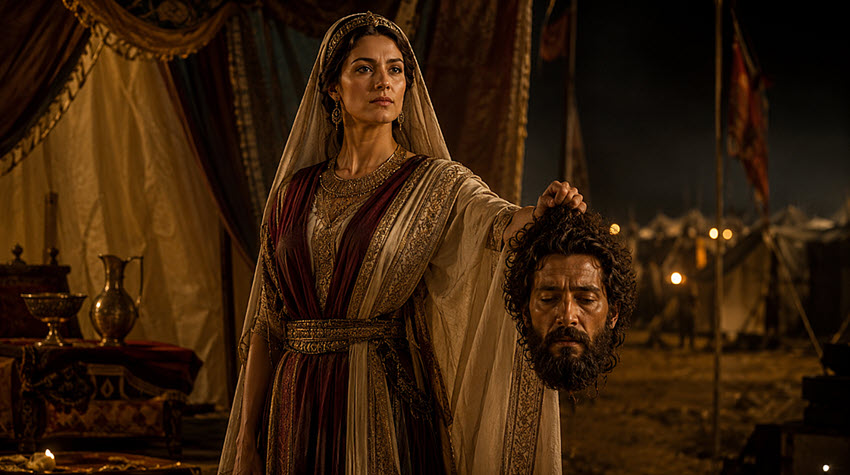
Joseph is brought to Egypt and sold to Potiphar—an official of Pharaoh and commander of the guard. Although Joseph is a slave, God is with him: his work prospers, and Potiphar’s household experiences a blessing. Potiphar clearly perceives this, so he places his trust in Joseph and appoints him steward over his entire household—entrusting practically everything into his hands, while reserving only his personal affairs for himself.
Over time, Potiphar’s wife begins to persistently tempt Joseph to sin. Eventually, the situation escalates to an attempted assault: the woman seizes him by his garment when Joseph is inside the house attending to his duties and no other household members are nearby. Joseph chooses to flee: he breaks free, leaving his garment behind in her hand, determined not to yield. It is this very garment—left behind—that becomes the instrument of a false accusation.
Potiphar’s wife summons the household staff and fabricates a story claiming that Joseph attempted to violate her; she displays the garment as „proof.” When Potiphar returns, she repeats this same version of events to him, fueling his anger. Stirred by the accusation, Potiphar orders Joseph to be imprisoned—he is cast into the prison where the king’s own prisoners were held.
3. Job – Perseverance and Faithfulness → Double Blessing:
“And YHWH restored Job’s fortunes when he prayed for his friends. YHWH gave Job twice as much as he had before. All his brothers and all his sisters and all his former acquaintances came to him and ate bread with him in his house. They showed him sympathy and comforted him concerning all the misfortune that YHWH had brought upon him. Each one gave him a coin and a gold ring. YHWH blessed the latter days of Job more than his beginning. He had fourteen thousand sheep, six thousand camels, a thousand yoke of oxen, and a thousand female donkeys. He also had seven sons and three daughters. In all the land, no women were found as beautiful as Job’s daughters, and their father gave them an inheritance among their brothers. After this, Job lived another one hundred and forty years and saw his sons and grandsons, even to the fourth generation. And Job died, old and full of days” – Job 42:10–17.
It is difficult to fully discuss the entirety of the trial Job endured; therefore, I recommend—dear Reader—that you read it yourself. This story serves as an incredible lesson for us on how to live—how to place faith and values above all else. Although at first glance it may appear that a righteous person suffers—that they lead a life inferior to that of the wealthy—in reality, the opposite is true.
4. Daniel – faithfulness to God despite the prohibition → exaltation:
“Now when Daniel learned that this document had been signed, he went into his house—and the windows in his upper room were open toward Jerusalem; three times a day he knelt, prayed, and gave praise to his God, just as he had done before.” — Daniel 6:11
What was the reward?
“Then the king exalted Daniel and gave him many gifts, and appointed him ruler over the whole province of Babylon” — Daniel 6:29.
Daniel is a high-ranking official in the kingdom of the Medes and Persians. His adversaries can find no fault in him. They therefore decide to strike at his faith rather than his competence. They succeed in having a decree issued: for thirty days, no one may pray to any god or man—only to the king. The law of the Medes and Persians was irrevocable—not even the king could repeal it. Daniel knows that he is breaking the law of the land and that he faces the penalty of death (the lions’ den).
5. David – Justice and Trust → Kingdom and Glory:
“YHWH rewards everyone according to his righteousness and faithfulness. Today YHWH delivered you into my hands, yet I did not lift my hand against YHWH’s anointed. Just as your life was precious in my eyes today, so may my life be precious in the eyes of YHWH.” — 1 Samuel 26:23–24
What was the reward?
“And David knew that YHWH had established him as king over Israel, and that He had exalted his kingdom for the sake of His people, Israel” – 2 Samuel 5:12.
David, having a genuine opportunity to kill Saul, consciously refrains from vengeance and entrusts the matter to God. He acknowledges that God is the sole Judge who recompenses according to justice and faithfulness, and that he himself will not raise his hand against God’s anointed.
6. Solomon – The Right Motivation of the Heart → Wisdom, Wealth, and Glory:
“And Solomon said: ‘You have shown great kindness to Your servant David, my father, because he walked before You in truth, righteousness, and uprightness of heart. Therefore, give Your servant an understanding heart, that he may know how to judge Your people’” – 1 Kings 3:6–9.
What was the reward?
“Because you asked for this—and did not ask for yourself for a long life, nor for riches, nor for the life of your enemies—I give you a wise and discerning heart; and furthermore, I also give you such riches and glory as no king before you has had, nor will any have after you.” — 1 Kings 3:11–13
Solomon, despite his great wisdom and initial closeness with God, allowed idols and false cults to turn his heart away, and this led to idolatry:
“When Solomon grew old, his wives turned his heart toward other gods, and his heart was no longer fully devoted to the LORD, His God, as the heart of David, his father” — 1 Kings 11:4.
7. Hezekiah – Trusting God in Crisis → Deliverance and Fame.
When Rabshakeh publicly reviled God and intimidated Judah, Hezekiah did not respond with pride or force. He turned to YHWH, asking Him to rebuke the blasphemy Himself:
“Thus says Hezekiah: ‘This day is a day of distress, rebuke, and disgrace… Perhaps YHWH your God will hear all the words of the Rabshakeh and rebuke him for the words with which he has taunted the living God.’” — 2 Kings 19:3–4.
What was the reward?
That very night, YHWH responded without the aid of a human army: His angel struck down 185,000 Assyrians in the camp.
“That night the angel of YHWH went out and struck down one hundred eighty-five thousand in the camp of the Assyrians. And when they rose in the morning, behold, they were all dead corpses.” — 2 Kings 19:35.
The result was the total defeat of the enemy and the deliverance of Jerusalem, as well as the exaltation of the name of YHWH—nations brought gifts to Jerusalem and to the king:
“And so YHWH saved Hezekiah… and many brought gifts to YHWH in Jerusalem, and valuables to Hezekiah.” — 2 Kings 19:36–37.
8. Ruth – Loyalty and Purity → Protection and Blessing.
Ruth, though she could have returned to her own country and former life, chooses to stay with Naomi and bind herself to the God of Israel with her whole heart:
“Do not urge me to leave you… Wherever you go, I will go, and wherever you live, I will live; your people shall be my people, and your God my God” – Ruth 1:16–17.
What was the reward?
God sees her faithfulness and promises full recompense and shelter:
“May YHWH reward your deed, and may your recompense be full from YHWH, the God of Israel, under whose wings you have come to take refuge.” — Ruth 2:12
Then that payment becomes visible to everyone—a house, a husband, and a child.
“Boaz took Ruth as his wife… And YHWH enabled her to conceive, and she bore a son” — Ruth 4:13.
9. Noah – Obedience Against the World → Salvation and Covenant
“He did everything just as God commanded him; so he did.” — Genesis 6:22
What was the reward?
“God blessed Noah and his sons, saying: ‘Be fruitful and multiply’” – Genesis 9:1.
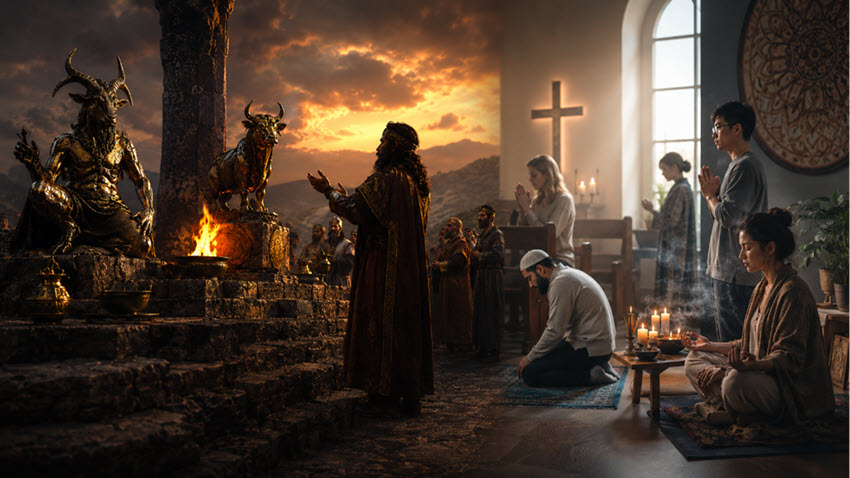
The earth was filled with wickedness and evil. Noah remained steadfast with God. He did not drift along with the current of the age—with the flow of the worldly way—but walked the path that God had appointed. This was no easy task, for he lived amidst people who were enamored with the life of the moment. That life must have been truly vile, horrific, and bestial, seeing as God decided to wipe it all away.
Noah’s faithfulness—his obedience and his unwavering faith in God’s plan—were not mere words, but a way of life: something he nurtured and demonstrated every single day.
Walking with God on a daily basis is no easy feat in a world shrouded in satanism…















Zapraszam do komentowania, wyrażania swojej opinii: