
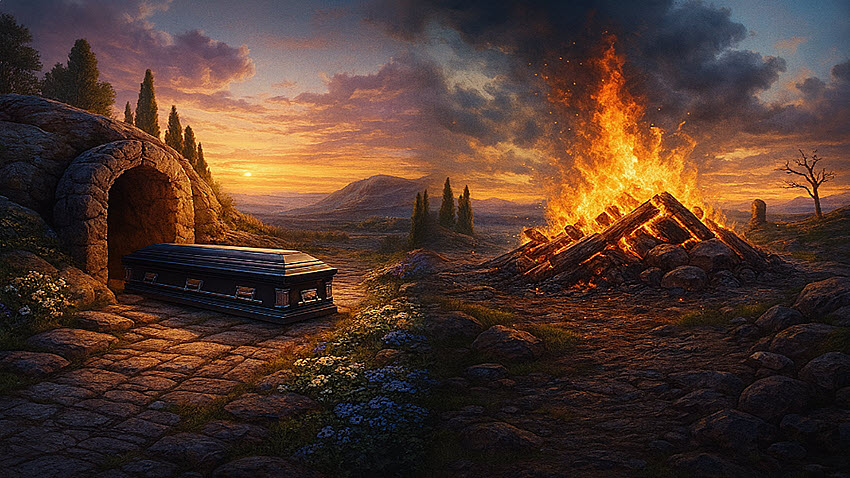
Which funeral should you choose? Cremate the body or bury it in a grave?
To answer the question “Is it better to cremate the body or bury it in a grave?”, let’s look at biblical examples.
How were the servants of the Most High God buried?
Let’s check.
Burials of God’s servants in the New Testament / New Covenant
1) The burial of John the Immerser
“And when His disciples heard of it, they came and took his body and buried / laid it in a tomb (G2290), and went and told Yeshu” — Mark 6:29.
2) The burial of the Lord Yeshu
“And He laid it in His own new tomb, which He had hewn out in the rock” — Matthew 27:60.
“And Joseph, having bought fine linen, took Him down, wrapped Him in the linen, and laid Him in a tomb which had been hewn out of rock” — Mark 15:46.
“And he laid Him in a tomb hewn out of rock, where no one had ever yet been buried / laid in a tomb (G2290)” — Luke 23:53.
3) The burial of Stephen
“And devout men buried / laid Stephen in a tomb (G2290), and made great lamentation over him” — Acts 8:2.
4) The burial of Ananias
“And the younger men arose, wrapped him up, carried him out, and buried / laid him in a tomb (G2290)” — Acts 5:6.
Conclusions
- In the New Testament / New Covenant there is not a single case of a holy person of God being burned after death. Fire is not for burial, but for judgment.
- Every true disciple of God is buried — not cremated. This applies to John the Baptist/the Immerser, Stephen, and (descriptively) also to the burial of Ananias and Sapphira (Acts 5:10).
- The most important burial is the burial of the Lord Yeshu — in a rock tomb, in linen cloths, with spices. The New Covenant highlights the dignity of the Messiah’s burial.
- The word “to bury” in the NT, θάπτω (G2290), means “to place the body in a tomb.” There is no other word suggesting cremation of the dead as a pious practice.
The burial of prophets in the Old Testament / Old Covenant
1) Abraham — buried in the cave of Machpelah
“They buried him in the cave of the field of Machpelah, opposite Mamre, in the land of Canaan” — Genesis 25:9–10.
How: placed in a rock cave that served as a family tomb.
Where: in the cave of Machpelah, on purchased land.
Who buried him: his sons Isaac and Ishmael.
2) Sarah — buried in the same cave
“After this, Abraham buried Sarah his wife in the cave of the field of Machpelah, opposite Mamre, in the land of Canaan” — Genesis 23:19.
How: with great honor, as the first in the new family tomb.
Where: the burial cave at Machpelah.
Who buried her: Abraham.
3) Isaac — buried with his family
“And Isaac died… and his sons Esau and Jacob buried him” — Genesis 35:29.
How: together with his fathers.
Where: in the family tomb.
Who buried him: Esau and Jacob.
4) Jacob (Israel) — embalmed, buried in the cave of Machpelah
“And his sons carried him into the land of Canaan and buried him in the cave of the field of Machpelah, which Abraham bought for a burial place” — Genesis 50:13.
How: embalmed in Egypt first; mourning and a ceremonial procession.
Where: the cave of Machpelah, in the family tomb.
Who buried him: his sons, with Egyptian dignitaries participating.
5) Joseph — buried in Shechem
“The bones of Joseph, which the sons of Israel brought up from Egypt, they buried in Shechem, in the piece of ground that Jacob bought…” — Joshua 24:32.
How: after years of carrying his bones through the wilderness, they fulfilled the oath given to Joseph.
Where: on inherited ground in Shechem, likely a family tomb/cave.
Who buried him: the sons of Israel.
6) Moses — buried by God, in a valley
“And He buried him in a valley in the land of Moab… but no one knows his grave to this day… The Israelites wept for Moses… thirty days” — Deuteronomy 34:6, 8.
How: uniquely, without human involvement; the grave’s location remains unknown.
Where: an unspecified grave in a valley.
Who buried him: YHWH Himself.
7) Aaron — buried on Mount Hor
“And Aaron died there on the top of the mountain… and he was buried there” — Numbers 20:28.
How: on the mountain top, in seclusion, with the priestly garments passed to Eleazar.
Where: likely a rock cave/tomb on Mount Hor.
Who buried him: Moses and Eleazar.
8) Samuel — buried at his house in Ramah
“And Samuel died… and all Israel gathered and lamented him, and buried him in his house in Ramah” — 1 Samuel 25:1.
How: with nationwide mourning; burial of a prophet, judge, and spiritual leader.
Where: at his home/estate in Ramah, likely a family rock tomb.
Who buried him: all of Israel.
9) David — buried in the City of David
“And David slept with his fathers and was buried in the City of David” — 1 Kings 2:10.
How: as a king, among ancestors, with full royal honors.
Where: royal tombs in the City of David (Jerusalem).
Who buried him: his son Solomon and royal servants.
10) Solomon — buried in the royal tombs
“And Solomon slept with his fathers and was buried in the City of David his father” — 1 Kings 11:43.
How: as David’s successor, in the same royal necropolis.
Where: a tomb in the City of David.
Who buried him: royal officials and his successor.
11) Elisha — buried in a tomb; his bones remained
“And Elisha died, and they buried him. And when the Moabites invaded the country the following year…” — 2 Kings 13:20.
How: as a recognized prophet; his grave was known and accessible.
Where: a rock tomb (later someone’s body was thrown into it and touched his bones).
Who buried him: the people of Israel.
12) Hezekiah — buried with great honor among David’s descendants
“And they buried him on the ascent of the tombs of the sons of David, and all Judah and the inhabitants of Jerusalem honored him” — 2 Chronicles 32:33.
How: with the highest respect, seen as one of the most devout kings.
Where: in an honored place in the royal necropolis.
Who buried him: his son Manasseh, and all Judah and Jerusalem.
Conclusions from the burials of prophets and patriarchs
- All God’s servants are buried, not burned. Burial is the norm — in every case there is a grave, cave, inherited field, the City of David. Cremation does not appear even once as the farewell for the faithful.
- Burial is an act of honor and faith. Prophets are buried in meaningful places (Machpelah, Mount Hor, City of David, the rise of David’s sons’ tombs). The grave is a place of remembrance, not contempt.
- Tombs are family-based and hereditary. Abraham buys the field and cave; Jacob and Joseph are buried in inherited places.
- Moses is the exception — buried by God. Only Moses is buried with no human involvement and with no known grave location, showing his unique role and that God did not want his body/grave to become an object of worship.
- Mourning for prophets is public and communal (all Israel mourns Samuel; all Jerusalem honors Hezekiah). The burial of the holy is a community event, not a private episode.
Who is burned in the Bible?
1) Achan and his family — burned after stoning
“And all Israel stoned him with stones; and they burned them with fire after they had stoned them with stones” — Joshua 7:25.
They were first stoned, then burned as a sign of judgment for taking devoted/accursed things.
2) A priest’s daughter — command to burn for sexual immorality
“If a priest’s daughter profanes herself by whoring, she profanes her father; she shall be burned with fire” — Leviticus 21:9.
The law mandates that a priest’s daughter be burned alive if she disgraces the sanctity of the priesthood – this is the highest form of punishment.
3) An apostate city — total burning
“You shall burn the city with fire, completely, as a burnt offering to YHWH your God; it shall remain a ruin forever, and shall not be rebuilt” – Deuteronomy 13:16.
A city that leads Israel astray to other gods is to be completely destroyed by fire.
4) Nadab and Abihu — burned by fire from YHWH
“Fire came out from YHWH and consumed them, and they died before YHWH” — Leviticus 10:2.
They offer „strange fire,” which God did not command – and the response is fire that consumes them.
5) Sodom and Gomorrah — destroyed by sulfur and fire
“YHWH rained on Sodom and Gomorrah sulfur and fire from YHWH out of heaven” — Genesis 19:24.
Entire cities, along with their inhabitants, are destroyed by fire.
6) Children burned for Molech — Israel’s crime
“They have built the high places of Topheth in the Valley of Ben Hinnom to burn their sons and daughters in the fire—something I did not command, nor did it enter my mind” – Jeremiah 7:31.
The people are sacrificing their own children, burning them as offerings to Moloch.
7) Soldiers sent against Elijah — burned by fire from heaven
“The fire of God came down from heaven and consumed him and his fifty” — 2 Kings 1:12.
Two more groups of fifty soldiers, sent with arrogance, are consumed by fire from heaven for their rebellion against God.
8) Moab and the bones of the king of Edom
“Thus says the Lord: ‘For three transgressions of Moab, and for four, I will not revoke the punishment, because he burned to lime the bones of the king of Edom” – Amos 2:1.
“I will send fire upon Moab, and it shall devour the palaces…” – Amos 2:2.
Moab burns bones as an act of disgrace; God announces fire of judgment.
9) The wicked on the day of YHWH — burned like stubble
“For behold, the day is coming, burning like a furnace; and all the proud, and all that do wickedly, shall be stubble: and the day that cometh shall burn them up, saith YHWH of hosts” – Malachi 4:1.
This is a prophetic image of the final judgment – the wicked are burned up like stubble; it is not a burial, but complete annihilation.
10) The fire of Gehenna — image of the condemned being burned
“It is better for you to enter life crippled than to have two hands and go into Gehenna, into the unquenchable fire, where their worm does not die and the fire is not quenched” – Mark 9:43–48 (cf. Isaiah 66:24).
Gehenna is the lake of fire, which is the second death.
11) The beast and the false prophet — thrown into the lake of fire
„The beast was captured, and with it the false prophet… Both of them were thrown alive into the lake of fire, burning with sulfur” - Revelation 19:20.
The final judgment on the antichrist system – thrown into the lake of fire.
12) The devil — finally thrown into the lake of fire
“And the devil, who deceived them, was thrown into the lake of fire and sulfur, where the beast and the false prophet are, and they will be tormented day and night forever and ever” – Revelation 20:10.
The final judgment of satan – his place is the lake of fire.
13) People not written in the book of life
“If anyone was not found written in the book of life, he was thrown into the lake of fire” — Revelation 20:15.
All who do not belong to God will end up not in the grave, but in the fire.
Topic summary
- In the Bible, holy people are always buried, not burned. Every faithful person — from Abraham to Stephen — receives a normal burial in a grave.
- Burning in the Bible signifies judgment and punishment. Fire touches rebels, the wicked, and God’s enemies.
- The grave and fire are two completely different paths: the grave means respect and hope of life; fire means destruction and condemnation.
- The Lord Yeshu is buried in a tomb.
- Cremation / burning is presented as a sign of judgment and a lack of respect toward the dead.





Zapraszam do komentowania, wyrażania swojej opinii: