

Various holidays have been established throughout the year—holidays that do not necessarily involve religious rites. They have both proponents and detractors.
Therefore, let us examine whether mother’s day, father’s day, and grandparents’ day are forbidden by God.
What does the Bible say?
The Commandment of Honoring Parents:
“Honor your father and your mother, that it may go well with you and that your days may be prolonged” – Exodus 20:12.
This commandment was repeated in the New Covenant:
“Children, obey your parents in the Lord… honor your father and mother” – Ephesians 6:1–3.
Household Piety
“Children and grandchildren should first show piety to their own household and repay their parents; this is pleasing to God.” — 1 Timothy 5:4
Neglecting one’s family is a grave transgression.
“If anyone does not provide for his relatives, and especially for his own household, he has denied the faith” – 1 Timothy 5:8.
Not every designated day is, in itself, a sin.
“One person regards one day above another, while another regards every day alike. Let each one be fully convinced in his own mind. He who observes the day, observes it for the Lord; he who eats, eats for the Lord, for he gives thanks to God. And he who does not eat, for the Lord he does not eat, and gives thanks to God” – Romans 14:5-6.
The verses cited above are interesting, so let us pause for a moment.
Let us examine the full context of the chapter. Paul begins by urging us to welcome the one who is weak in faith—not for the purpose of disputing over opinions—and immediately thereafter offers an example: one person eats everything, while another eats only vegetables. He then speaks of „days,” and subsequently returns once again to the subject of eating and abstaining. This demonstrates that the matter at hand concerns issues of conscience.
The most immediate interpretation may be this: some people singled out certain days, while others did not distinguish any days at all. Since, in verse 6, the word „day” appears alongside references to „eating” and „not eating,” the reference may be to days associated with fasting, abstaining from specific foods, or privately setting aside a day for the Lord. The text itself does not specify the names of these days, yet the context clearly links them to matters of diet and conscience.
Paul is not saying here: „all holidays are good,” nor: „one may participate in anything whatsoever.” Rather, he is saying that in matters which are not inherently sinful, we must not impose burdens upon one another or pass judgment on one another. This is subsequently confirmed by the statement: „For the Kingdom of God is not a matter of eating and drinking, but of righteousness, peace, and joy in the Holy Spirit” (Romans 14:17).
This passage does not teach that it is permissible to participate in festivals honoring idols or in practices tainted by demons. Elsewhere, Paul states explicitly that the sacrifices of pagans are offered to demons, and that one cannot partake simultaneously of the Lord’s table and the table of demons. Therefore, Romans 14 cannot be used to justify idolatry.
Paul strikes out against imposed human tradition:
“Let no one judge you regarding food, drink, a festival, a new moon, or a sabbath” — Colossians 2:16–17.
Earlier, Paul warns against philosophy, empty deception, and the traditions of people living outside of Christ. Immediately following verse 17, he also warns against those who delight in a feigned humility and the worship of angels. Furthermore, he speaks of human precepts—such as „do not touch, do not taste, do not handle”—which he characterizes as the commandments and teachings of men, and as something possessing only the appearance of wisdom. This demonstrates that the entire passage targets human religiosity—that which is imposed upon man.
Human tradition cannot nullify the Word of God.
“You have abandoned the commandment of God and hold to the tradition of men… nullifying the word of God by your tradition” — Mark 7:8–13.
Lord Yeshu condemned the tradition that withheld aid from one’s father and mother.
„But you say: 'If a man says to his father or mother: „Corban”—that is, a gift—”is that which from me could help you,” then you no longer allow him to do anything for his father or mother. Thus nullifying the word of God by your tradition, which you have handed down. And you do many similar things.'” — Mark 7:11–13
Korban = a gift or offering declared as dedicated to God. If a religious tradition leads to the neglect of one’s parents, then—according to the words of Christ—such a tradition is false.
A mother is to rejoice in the righteous lives of her children.
“Do not despise your mother when she grows old… let her who gave you birth rejoice” — Proverbs 23:22–25.
What can we conclude from this?
1. Respect and honor for mom, dad, grandma, and grandpa are Biblical.
The Bible does not command God’s servants to be cold toward their families, but rather to show respect, care, gratitude, and practical assistance. A gift, a phone call, a visit, a meal, or a word of gratitude—these things are good and in accordance with Scripture, provided they stem from love and a clear conscience.
2. When holidays are a human custom, and not a commandment of God.
The Bible commands us to honor our parents continually, not merely once a year. Therefore, one must not say, „God commanded us to observe Mother’s Day”—for Scripture does not say this. This is precisely where the principle from Mark 7 applies: one must not elevate human traditions to the status of God’s commandments.
3. One must not participate when witnessing idolatry or pressure on one’s conscience.
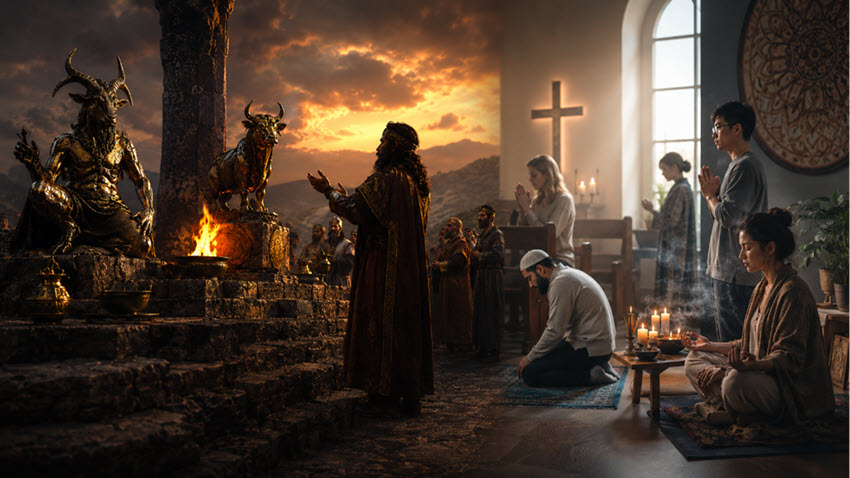
If someone mixes the holidays with the veneration of images, prayers, or religious rites directed toward foreign gods—with a „table of demons”—or demands that others acknowledge such a day as holy by divine command, then a servant of God should refuse. This is no longer merely a matter of ordinary family respect, but a crossing of the line.
The primary objection raised against these holidays is that a servant of God should not participate in celebrations organized by the world, as one cannot be certain that they do not conceal idols, hidden satanism, or festivities held in honor of gods or demons.
A servant of God cannot disregard the origins and substance of any holiday. The Bible warns against nations that serve their own gods and forbids transferring these rituals into the service of God. Paul, too, speaks plainly: flee from idolatry and do not become a participant at the „table of demons.” This constitutes a firm boundary.
However, let us be precise. The Bible does not assert that everything organized by the world is automatically tainted. On the contrary, Paul presents a scenario in which—if an unbeliever invites you and you wish to attend—you may eat without inquiring further; only when it is explicitly stated, „this is an offering to an idol,” must you decline—not for the sake of your own conscience, but for the sake of the conscience of the person who drew your attention to the matter.
“Everything is permissible—but not everything is beneficial; everything is permissible—but not everything builds up. Let no one seek his own good, but the good of another. Eat whatever is sold in the meat market, asking no questions for the sake of conscience. For the earth is the Lord’s, and its fullness. If one of the unbelievers invites you to a meal and you want to go, eat whatever is set before you, asking no questions for the sake of conscience. But if someone says to you, ‘This has been offered to idols,’ do not eat it—for the sake of the one who informed you, and for the sake of conscience. I mean not your own conscience, but the other person’s. For why should my freedom be judged by another’s conscience? If I partake with thankfulness, why should I be denounced because of that for which I give thanks? So whether you eat or drink or whatever you do, do it all for the glory of God. Do not cause anyone to stumble—neither Judeans, nor Greeks, nor the assembly of God—just as I try to please everyone in every way, not seeking my own benefit but the benefit of many, so that they may be saved” – 1 Corinthians 10:23-33.
“Test everything; hold fast to what is good” – 1 Thessalonians 5:21.
“Abstain from every form of evil” – 1 Thessalonians 5:22.
“Whatever does not proceed from faith is sin” – Romans 14:23.
We can view it this way: if something is overtly idolatrous—reject it; if you are unsure—investigate; if, after investigating, you still lack peace of conscience—do not participate. This is not cowardice, but rather obedience to the laws of Christ.
So, what about Mother’s Day, Grandmother’s Day, and Grandfather’s Day?
The mere fact that a particular day has been designated by people and is observed within society does not, in itself, constitute the worship of an idol. However, if a specific celebration were to involve: prayers to the deceased, the veneration of images, rituals honoring other figures, occult practices, drunken revelry, or overt elements dedicated to idols—then a servant of God must decline to participate. Conversely, the simple act of showing honor to one’s mother, grandmother, or grandfather is not, in itself, idolatry.
One must also be cautious…
Lord Yeshu condemned not only false worship but also human traditions that nullify the commandments of God. In Mark 7, the issue was that people used religious tradition as a pretext to avoid actually providing aid to their father and mother. This sheds a very strong light on the subject: God values genuine respect and love for one’s parents far more than the name of a specific day on the calendar.
Should a servant of God reject every holiday simply because „the world organized it” or because „there might be something hidden behind it”?
The Bible does not say this. The Bible states something more precise:
• One must not participate in anything that is genuinely associated with idols, demons, or foreign worship;
• On the one hand, we should examine the origins and content of holidays; yet, on the other hand, we have the principle: „asking no questions for the sake of conscience.”
• One must not participate in them if one’s conscience condemns one.
Before making a decision, it is worth analyzing these verses further and reading the text on this subject:
Communions – Weddings – Holidays. When is it a Sin against the Holy Spirit?
“For freedom Christ has set us free; stand firm, therefore, and do not submit again to a yoke of slavery” – Galatians 5:1.
“You observe days and months and seasons and years! I am afraid I may have labored over you in vain” – Galatians 4:10-11.
“So, whether you eat or drink, or whatever you do, do all to the glory of God” – 1 Corinthians 10:31.
“Do not be conformed to this world, but be transformed by the renewal of your mind, that you may discern what is the will of God: what is good, acceptable, and perfect” – Romans 12:2.
“Abstain from every form of evil” – 1 Thessalonians 5:22.
“All things are lawful, but not all things are profitable; all things are lawful, but not all things build up” – 1 Corinthians 10:23.
“But take care that this liberty of yours does not somehow become a stumbling block to the weak” – 1 Corinthians 8:9.
“For God said: ‘Honor your father and mother,’ and ‘Whoever reviles father or mother must surely die’” – Matthew 15:4.
“Grandchildren are the crown of the aged, and fathers are the glory of their children” – Proverbs 17:6.
“What agreement does the temple of God have with idols? For you are the temple of the living God, just as God said: ‘I will dwell in them and walk among them, and I will be their God, and they shall be My people. Therefore, come out from among them and be separate,’ says the Lord, ‘and do not touch what is unclean, and I will receive you.’” – 2 Corinthians 6:16-17. .
Finally, let us address the word „honor”:
In Scripture, the word denoting honor does not always refer exclusively to God. The Bible commands us to honor our father and mother, to honor the elderly, and even states: „Honor the king.” In this sense, it signifies respect, esteem, recognition of another’s dignity, and proper treatment. This does not constitute idolatry.
We must, therefore, distinguish between two things:
• The first is to honor a human being in a dignified and appropriate manner.
• The second is to render worship, adoration, and glory—which belong exclusively to God.
When a person crosses this boundary and begins to give to a created being that which belongs to the Creator, they then fall into idolatry.
Therefore, one need not fear the word „honor” itself, provided it is understood in a biblical sense. Honor—in the sense of esteem and respect—may be shown to parents, elders, or those in authority. However, adoration, worship, and supreme glory belong to God alone.
This is precisely the Biblical balance.












Zapraszam do komentowania, wyrażania swojej opinii: