
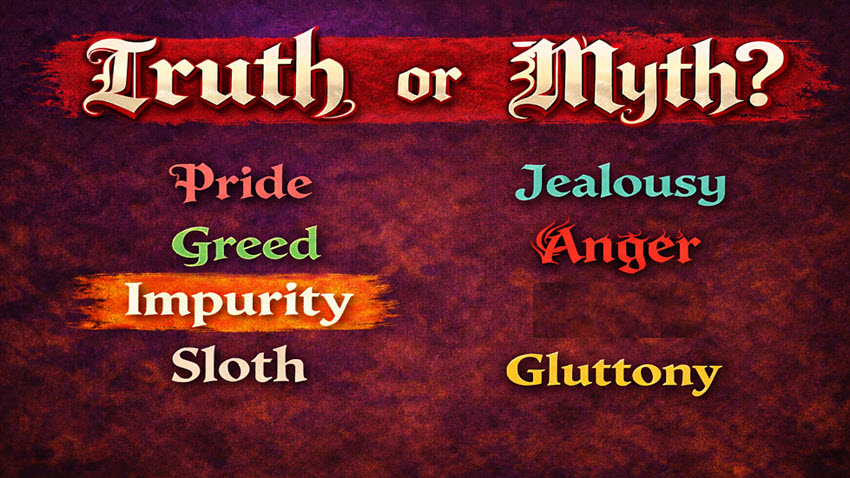
The Catechism of the Catholic Church lists the so-called „capital sins”:
1. pride,
2. greed,
3. envy,
4. anger,
5. lust,
6. gluttony,
7. sloth.
Are the Seven Deadly Sins consistent with the Bible?
First, an important clarification: the Bible does not provide a single, „official” list of the „7 Deadly Sins.” This is the work of the Catholic Church. However, each of these seven sins is very clearly condemned in Scripture. Let’s see based on selected verses.
1 – Pride – Consistent: the Bible condemns
Pride leads to ruin:
„Pride goes before destruction, and a haughty spirit before a fall.” – Proverbs 16:18
2 – Greed – Consistent
Life is not about accumulating:
„Beware of all covetousness, for life does not come from abundance” – Luke 12:15.
3 – Impurity (lust) – consistent
Sin begins in the heart:
„Whoever looks at a woman to lust after her has already committed adultery with her in his heart” – Matthew 5:28.
4 – Jealousy – consistent
The Bible often describes envy as an „evil eye” and as something that originates in the heart. From the heart also come the „evil eye” and pride:
„Theft, greed, malice, deceit, licentiousness, an evil eye, blasphemy, pride, foolishness” – Mark 7:22.
5 – Gniew — zgodne
Anger destroys relationships and is subject to judgment:
„Whoever is angry with his brother will be subject to judgment” – Matthew 5:22.
6 – Gluttony– consistent
The Bible doesn’t just talk about eating, but about making the „belly” an idol (their life’s master). When the „belly” becomes a god:
„Their god is the belly” – Philippians 3:19.
7 – Laziness – consistent
Learn wisdom from the ant:
„Go to the ant, you sluggard; consider its ways and be wise.” – Proverbs 6:6
Is the choice of the Seven Deadly Sins a good one?
It all depends on how we approach this topic. If someone says these sins are unimportant, they are mistaken. Christ’s teachings, as well as all of Scripture, tell us to avoid these sins. Anyone who ignores this advice will fail: spiritually, mentally, and physically.
If someone says that these are the most important sins and that all it takes is to avoid them and everything will be fine, then this may not be enough to persevere in wise resolutions to the end.
Let’s look at the most important commandments and principles of faith passed down by Christ and the apostles.
1 – The Commandment of Love
„Teacher, which is the greatest commandment? And He said to him, 'You shall love the Lord your God with all your heart, and with all your soul, and with all your mind.’ This is the great and first commandment. And the second is like it: You shall love your neighbor as yourself. On these two commandments hang all the law and the prophets.” – Matthew 22:36-40.
Anger, envy, impurity, greed, and pride fall under these two most important commandments.
2 – Sin Against the Holy Spirit
There is one sin that God takes very seriously:
„I tell you, all sins will be forgiven the sons of men, even blasphemies (987), whatever they commit. But whoever blasphemes (987) against the Holy Spirit has no forgiveness in this aeon, but is subject to aeon judgment” – Mark 3:28-29.
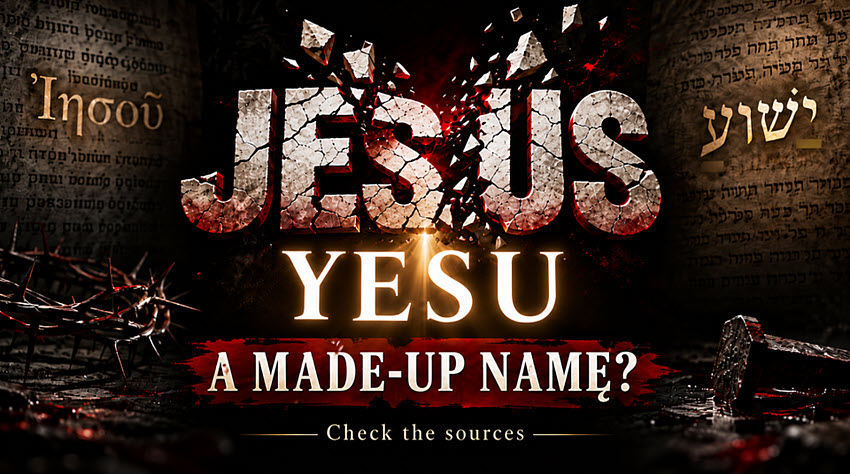
3 – The commandment to believe in the correct name of Christ:
“And this is His commandment, that we should believe in the name of His Son, Yeshu Christ, and love one another, just as He has commanded us” – 1 John 3:23 (Millennial).
„And whatever you ask in My name, this I will do, that the Father may be glorified in the Son. And whatever you ask Me in My name, I will do. If you love Me, you will keep My commandments” – John 14:13-15.
This is how the name of Christ is written in Greek:
„And the messenger said to her, 'Do not be afraid, Mariam/Miriam, for you have found favor with God. Behold, you will conceive in your womb and bear a son, and you shall call his name Yeshu/Yesu-n.'” – Luke 1:31.
In the true name of Christ, we have salvation, eternal life:
„And there is salvation in no one else: for there is no other name under heaven given among men by which we must be saved” – Acts 4:12 (Millennial).
“These are written that you may believe that Yeshu is the Christ, the Son of God, and that by believing you may have life in His name” – John 20:31.
More here:
Basics of Faith: Do You Believe in the Name of Christ? – Part 2
4 – Idolatry – praying to images
The First Commandment – the Ten Commandments:
„Then God spoke all these words: 'I am the LORD your God, who brought you out of the land of Egypt, out of the house of slavery. You shall have no other gods before me. You shall not make for yourself any carved image, or any likeness of anything that is in heaven above, or that is in the earth beneath, or that is in the water under the earth. You shall not bow down to them or serve them. For I, the LORD your God, am a jealous God, visiting the iniquity of the fathers upon the children to the third and fourth generation of those who hate me.” – Exodus 20:1-5
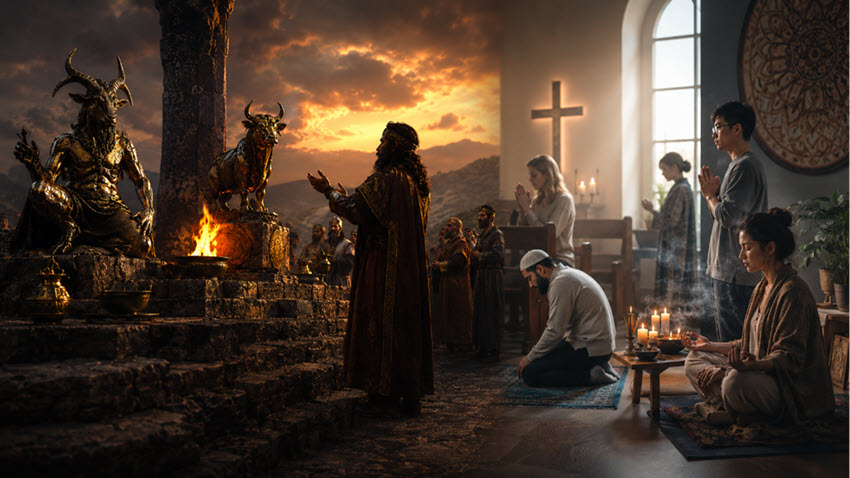
The Decalogue prohibits the making of any images for prayer or worship. Notice that it prohibits praying „through” and „to” images/statues/figures, etc.
These are strong words. They also appear in subsequent books of the Old and New Testaments.
Here’s an example – they became fools, exchanging images for God:
„Claiming to be wise, they became fools. They exchanged the glory of the immortal God for images like corruptible man, birds, four-footed beasts, and creeping things” – Romans 1:22-23 (ESV).
Is it allowed to pray to God through images, crosses, and figurines?
3 – The Father and the Son, or the doctrine of the Trinity
The doctrine of the trinity and the binaural have no Biblical foundation. If the trinity or the binaural were true doctrines, meaning that the Father and the Son are the same Person, then Christ would be lying in the following verse:
„But it is written in your Law that the testimony of two men is true. I testify about Myself, and the Father who sent Me testifies about Me. Then they said to Him, 'Where is your Father?’ Yeshu answered, 'You know neither Me nor my Father. If you knew Me, you would know My Father also.'” – John 8:17-19
“…I go to the Father, because the Father is greater than I” – John 14:28.
The Son appeals to the testimony of the Father and the Son; if the Son were the Father, Christ would be lying.
Another thing: to whom was the Son praying? To Himself? If that were the case, the Son would be making a circus…
The Son prays to the Father:
„When Yeshu had said this, He lifted up His eyes to heaven and said, 'Father, the hour has come; glorify Your Son, that the Son may glorify You.'” – John 17:1.
„Yeshu lifted up His eyes and said, 'Father, I thank You that You have heard Me. I knew that You always hear Me.'” – John 11:41-42.
What about the verses that say the Father and the Son are one?
“I and the Father are one/unity (1520)” – John 10:30.
“Hear, O Israel, YHWH is our God, YHWH is one/only/unity (1520)” – Deuteronomy 6:4.
And what is one?
„I pray not only for these, but also for those who will believe in Me through their word, that they may all be one(1520), just as You, Father, are in Me, and I in You, that they also may be one(1520) in Us, so that the world may believe that You have sent Me. And the glory You have given Me I have given to them, that they may be one(1520), just as We are one(1520)” – John 17:20-22.
„But all these things worketh one and the same Spirit, dividing to each individually as He wills. For as the body is one and has many members, and all the members of the body, though many, are one body, so also is Christ. For also by one Spirit we were all immersed into one body, whether Judeans or Helenians (Greeks), whether slaves or free, and were all made to drink of one Spirit. For the body also is not one member, but many” – 1 Corinthians 12:11-14 (Jeshu.org).
Let’s Summarize
The seven deadly sins are important prohibitions. By doing these things, we unnecessarily expose ourselves to difficult life situations, health-related, mental, and spiritual. We can blame God for a given life situation or ask Him to fulfill certain things, and God clearly tells us in the Scriptures what to do and what to avoid to be happy and for our prayers to be answered.
Since we commit these sins ourselves…
Let us first work on ourselves to eliminate these evil behaviors.
Let us also pay attention to other important commandments. Christ clearly says: „If you love Me, you will keep My commandments.”
Therefore, the commandments about love—the commandment to believe in the true name of Christ—the prohibition against using images, the prohibition against the Trinity…












Zapraszam do komentowania, wyrażania swojej opinii: