
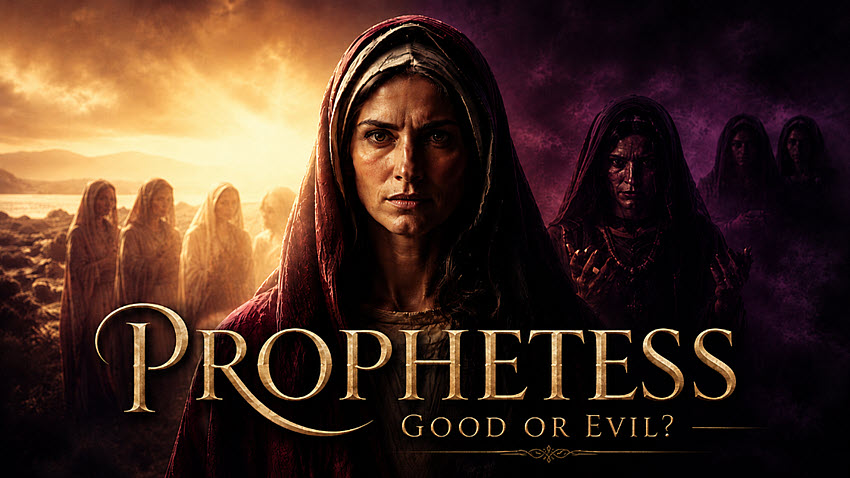
Could a woman speak on behalf of God?
For many people, the question itself is uncomfortable. Some will immediately say, „A woman must remain silent.” Others will say, „A woman can do everything just as a man does.”
But the Bible follows neither the path of religious prohibition nor the path of modern-day rebellion.
The Bible reveals something simpler and more powerful: there were women whom God designated as prophetesses. There were also women who prophesied falsely and led people astray.
Therefore, it is not enough to say, „She is a woman, so she cannot speak.” Nor is it enough to say, „She is a prophetess, so she must be believed.”
Scripture shows that one must examine the source, the spirit, the fruits, and the alignment with God’s Word.
For the problem is not the woman herself. The problem lies in lies, pride, chaos, deception, and the voicing of one’s own private opinions instead of God’s teachings.
9 – Examples of good and bad prophetesses
9.1 Examples of good prophetesses
The Bible shows that women were prophetesses. This is neither a conjecture nor a religious tradition, but the straightforward testimony of Scripture. Some women are explicitly called prophetesses, while others are described as having prophesied.
Miriam — prophetess, sister of Aaron and Moses;
„Then Miriam (Greek: Mariam), the prophetess, the sister of Aaron, took a tambourine in her hand, and all the women went out after her with tambourines and in dances” — Exodus 15:20.
Miriam is explicitly called a prophetess. She was a woman through whom God worked among Israel. However, it must be remembered that Miriam was later rebuked when she and Aaron rose up against Moses:
“Why, then, were you not afraid to speak against My servant, against Moses?” — Numbers 12:8.
This illustrates an important principle: a true gift does not make a person infallible. The prophetess must still exercise self-control over her actions.
Deborah—prophetess and judge of Israel:
„Now Deborah, a prophetess, the wife of Lappidoth, was judging Israel at that time” — Judges 4:4.
Deborah was a prophetess and a judge. The Israelites came to her for a verdict. This example clearly shows that God can use a woman to convey a word, wisdom, and judgment.
Huldah — a prophetess in Jerusalem:
„So Hilkiah the priest, Ahikam, Achbor, Shaphan, and Asaiah went to Huldah the prophetess, the wife of Shallum son of Tikvah, son of Harhas, keeper of the wardrobe—she lived in Jerusalem, in the Second Quarter—and they spoke with her” — 2 Kings 22:14.
„So Hilkiah and those whom the king had appointed went to Huldah the prophetess, the wife of Shallum son of Tokhath, son of Hasrah, keeper of the wardrobe—she lived in Jerusalem, in the Second Quarter—and they spoke with her about this” — 2 Chronicles 34:22.
Huldah was a prophetess whom the priest and the king’s men visited. She was not treated as just anyone; they came to her to hear a word from God.
The prophetess, wife of Isaiah:
„Then I approached the prophetess, and she conceived and gave birth to a son. And the Lord said to me: Name him Maher-shalal-hash-baz” — Isaiah 8:3.
The text does not give her name but calls her a prophetess. We do not have an extensive description of her ministry here, but the title itself is significant.
Anna — a prophetess from the tribe of Asher:
“There was also Anna, a prophetess, the daughter of Phanuel, of the tribe of Asher. She was very advanced in years; she had lived with her husband for seven years from the time of her virginity” — Luke 2:36.
“And coming up at that very hour, she gave thanks to God and spoke about Him to all who were awaiting the redemption of Jerusalem” — Luke 2:38.
Anna was a prophetess who remained devoted to God through prayer and fasting. When she saw the child Yeshu, she spoke about Him to those awaiting redemption.
Philip’s four daughters—virgins who prophesied:
“And he had four virgin daughters who prophesied” — Acts 21:9.
The text does not use the noun “prophetesses” to describe them, but it states explicitly that they prophesied. This is significant because it demonstrates the practical exercise of the gift of prophecy by women.
Daughters and handmaidens shall prophesy:
„And it shall come to pass afterward that I will pour out My Spirit on all flesh; your sons and your daughters shall prophesy, your old men shall dream dreams, and your young men shall see visions” — Joel 2:28.
„Even on the menservants and maidservants I will pour out My Spirit in those days” — Joel 2:29.
This text is very important because it speaks not only of sons but also of daughters. God foretells the outpouring of the Spirit upon women as well.
Peter cited this passage on the Day of Pentecost:
“And it shall come to pass in the last days—says God—that I will pour out of My Spirit on all flesh; your sons and your daughters shall prophesy, your young men shall see visions, and your old men shall dream dreams” — Acts 2:17.
“Even on My menservants and maidservants I will pour out of My Spirit in those days, and they shall prophesy” — Acts 2:18.
The outpouring of the Spirit also extends to daughters and female servants.
A woman praying and prophesying:
„But every woman who prays or prophesies with her head uncovered dishonors her head; for it is one and the same as if she were shaved” — 1 Corinthians 11:5.
This verse is very important. Paul does not say here: „a woman can never prophesy.” On the contrary, he describes a situation in which a woman prays and prophesies.
For more information, please see the article:
Women Were Prophetesses and Deaconesses – Jesu.pl
9.2 — Examples of false prophetesses
The Bible also shows the other side: a woman may speak as a prophetess, but she may also prophesy falsely. Therefore, the title alone is not enough; one must examine whether the word comes from God.
Women prophesying out of their own hearts:
„And you, Son of Man, set your face against the daughters of your people who prophesy out of their own hearts, and prophesy against them. And say: Thus says the Lord God: Woe to the women who sew bands on all wrists and make veils for the heads of people of every stature, to hunt down souls. Will you hunt down the souls of My people and keep your own souls alive? You profane Me among My people for a handful of barley and for a piece of bread, killing souls that should not die and keeping alive souls that should not live, as you lie to My people who listen to lies. Therefore, thus says the Lord God: Behold, I am against your bands with which you hunt souls like birds; I will tear them from your arms and let go the souls that you hunt like birds. I will also tear off your veils and deliver My people from your hand, and they shall no longer be prey in your hand; and you shall know that I am the Lord. Because with lies you have saddened the heart of the righteous, whom I have not saddened, and strengthened the hands of the wicked, so that he does not turn from his evil way and live. Therefore, you shall no longer see vanity nor practice divination; I will deliver My people from your hand, and you shall know that I am the Lord” — Ezekiel 13:17-23.
This text strongly demonstrates that God is opposed to acting on one’s own initiative. The problem is not that the women spoke; the problem is that they spoke lies, misled the people, emboldened the wicked, and hurt the righteous.
Noadiah — a prophetess who intimidated Nehemiah:
“My God, remember Tobiah and Sanballat according to these deeds of theirs, as well as the prophetess Noadiah and the rest of the prophets who sought to frighten me” — Nehemiah 6:14.
Noadiah is called a prophetess, yet she stands on the side of evil. This demonstrates that it is not the title „prophetess” itself that is decisive, but rather the alignment of one’s words, spirit, and fruits with God.
Jezebel in the Revelation of John—a woman who calls herself a prophetess:
„But I have this against you: that you allow the woman Jezebel, who calls herself a prophetess, to teach and mislead My servants into committing sexual immorality and eating food sacrificed to idols.And I gave her time to repent, but she refuses to repent of her sexual immorality. Behold, I will cast her onto a bed of suffering, and those who commit adultery with her into great tribulation, unless they repent of her deeds.” And I will strike her children dead; and all the churches shall know that I am He who searches the minds and hearts, and I will give to each of you according to your deeds” — Revelation 2:20-23.
This is a very important text because it links two themes: the woman „calls herself a prophetess” and she „teaches and leads astray.” The Lord Yeshu rebukes her not because she speaks at all, but because she leads God’s servants into sexual immorality and idolatry.
This confirms the principle: prophecy must be tested, and false teaching must be rejected.
9.3 — How to examine prophecy?
The Bible does not say to blindly accept every prophecy. Prophecy must be examined.
“Do not treat prophecies with contempt; test everything; hold fast to what is good” — 1 Thessalonians 5:20–21.
“Let two or three prophets speak, and let the others weigh what is said” — 1 Corinthians 14:29.
This applies to everyone: men and women alike. True prophecy is not a matter of private human opinion; it originates from God and must align with truth, order, and holiness.
The Bible clearly shows that there were godly prophetesses—such as Miriam, Deborah, Huldah, the prophetess who was Isaiah’s wife, Anna, and the daughters of Philip—who prophesied. Scripture also reveals that God foretold the prophesying of sons and daughters, as well as the outpouring of the Spirit upon both male and female servants.
The Bible also presents negative examples: women prophesying out of their own hearts and relying on their own convictions or opinions—such as Noadiah, who sought to intimidate Nehemiah, and Jezebel, who claimed to be a prophetess yet led God’s servants astray.
The Bible does not reject prophecy simply because it is spoken by a woman. Rather, it rejects false prophecy, deception, chaos, sexual immorality, idolatry, and the proclamation of one’s own philosophy instead of God’s truth.
Paul does not forbid women from speaking altogether; he forbids chaos, insubordination, and the usurpation of teaching authority over men. Prophecy from God, however, is neither a woman’s private opinion nor mere teaching based on personal views; it is a word from the Holy Spirit that must be tested.
Therefore, the Biblical principle is simple: true prophecy is to be tested and accepted if it comes from God, while false prophecy must be rejected—regardless of whether it is spoken by a man or a woman.














Zapraszam do komentowania, wyrażania swojej opinii: