
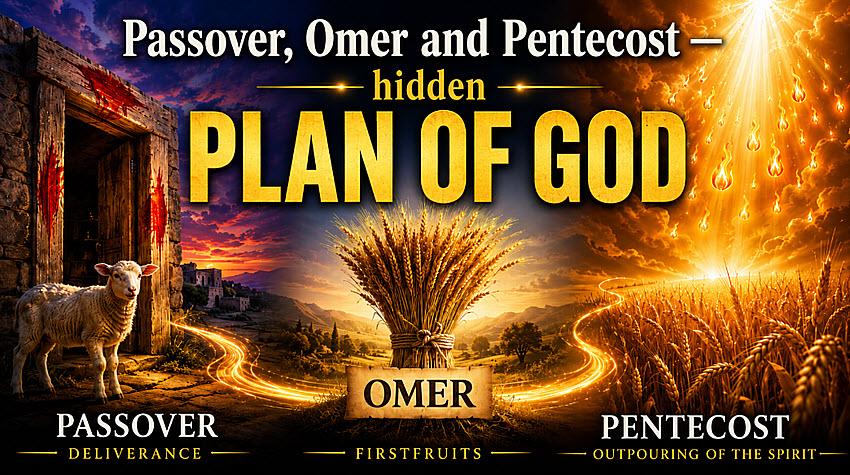
15 – How long did the Israelite festivals—Passover, Unleavened Bread, the Omer, and Pentecost—last?
15.1 Passover – 14th of Abib – lasted one day:
„And on the fourteenth day of this month at twilight is the Passover to YHWH” – Leviticus 23:5.
The Passover lasted from the evening of the 13th/14th of Aviv to the evening of the 14th/15th.
15.2 Feast of Unleavened Bread – lasted from the 15th to the 21st of Aviv – 7 days:
„And on the fifteenth day of this month is the Feast of Unleavened Bread to YHWH; for seven days you shall eat unleavened bread” – Leviticus 23:6.
„For seven days you shall eat unleavened bread” – Exodus 12:15.
The Feast of Unleavened Bread lasted seven days, from the evening of the 14th/15th to the evening of the 21st/22nd of Aviv.
15.3 Omer — the day of the sheaf of firstfruits; according to the first method of counting: the 16th of Aviv; according to the second: after the weekly Sabbath:
„And you shall bring the sheaf of the firstfruits of your harvest to the priest” – Leviticus 23:10.
„And the priest shall wave it before YHWH, to be accepted on your behalf; on the day after the sabbath, the priest shall wave it” – Leviticus 23:11.
„You shall not eat bread, nor roasted grain, nor fresh ears of grain until this very day, until you bring the offering of your God” – Leviticus 23:14.
„And you shall count for yourselves from the day after the sabbath, from the day on which you brought the wave sheaf; seven full sabbaths” – Leviticus 23:15.
Passover falls on the 14th of Aviv, and the first day of the Feast of Unleavened Bread falls on the 15th of Aviv.
Two ways of understanding the word „sabbath” in Leviticus 23:11 arise here:
• The first method of counting
If „sabbath” is understood as the festive rest of the first day of the Feast of Unleavened Bread—that is, the 15th of Aviv—then „the day after the sabbath” falls on the 16th of Aviv.
In this case, the Omer (the sheaf of the firstfruits of the harvest) was offered on the 16th of Aviv. From that day, it was permitted to eat the new grain, and the counting of the seven weeks leading up to Pentecost began.
• The second method of counting
If „sabbath” is understood as the weekly sabbath—that is, the seventh day of the week—then the Omer offering was presented on the day following that sabbath, meaning the first day of the week.
In this case, the date of the Omer was not fixed; it could fall on different days of the month of Aviv, depending on when the weekly sabbath occurred during the Feast of Unleavened Bread.
What both methods of counting have in common is that the Omer marked the day of the harvest’s firstfruits. From that day on, it was permitted to consume the new grain, and the counting of the seven weeks leading up to Pentecost began.
15.4. Counting of the Omer – 7 weeks = 49 days
„And you shall count from the day following the sabbath, from the day you brought the wave sheaf, seven full weeks” – Leviticus 23:15.
„You shall count fifty days up to the day following the seventh sabbath” – Leviticus 23:16.
In the Greek text of the Septuagint, the meaning is: „until the day after the seventh sabbath, you shall count fifty days.”
How does one count using the first method?
If the Omer is Day 1, then:
• 16 Aviv Omer – day 1,
• 17 Aviv – day 2.
• 18 Aviv – day 3,
…
• day 49 = seventh Sabbath (7 × 7),
• day 50 = the day after the seventh Sabbath = Pentecost.
15.5 Pentecost – 50th day – lasted 1 day:
„Then you shall present a new grain offering to YHWH” – Leviticus 23:16.
„You shall observe the Festival of Weeks, the firstfruits of the wheat harvest” – Exodus 34:22.
Pentecost was a one-day festival falling on the fiftieth day of the count, with the day of the Omer being the first day.
15.6 The entire sequence at a glance:
• Passover – 14 Aviv – 1 day.
• Unleavened Bread – 15–21 Aviv – 7 days.
• Omer – 16 Aviv – start of the counting (first method).
• 7 weeks of harvest – 49 days.
• Pentecost – 50th day – 1 day.
The counting from the Omer to Pentecost spanned fifty days. The entire spring sequence began with Passover on the 14th of Aviv; thus, the period from Passover to Pentecost lasted slightly more than fifty days.
16 – What exactly did the following signify: Passover → Unleavened Bread → Omer → 7 Weeks → Pentecost?
16.1 The Meaning of Passover
„On that night I will pass through Egypt, strike down every firstborn in the land of Egypt—both man and beast—and execute judgment against all the gods of Egypt—I am the LORD. The blood shall be a sign for you on the houses where you dwell; when I see the blood, I will pass over (H6452 *pasach* — to pass over / spare / 'Pesach-passing over’) you. This day shall be a memorial for you, and you shall celebrate it as a festival to YHWH; throughout your generations you shall celebrate it as an everlasting ordinance” – Exodus 12:12-14.
„This is the sacrifice (H2077 *zevach* — sacrifice / sacrificial offering) of the Passover (H6453 *Pesach* — Passover) to YHWH, who passed over (H6452 *pasach* — to pass over / spare; 'Pesach-passing over’) the houses of the children of Israel in Egypt when He struck the Egyptians and spared our houses” – Exodus 12:27.
„Observe the month of Aviv and celebrate the Passover to the YHWH, for in the month of Aviv YHWH brought you out of Egypt by night” – Deuteronomy 16:1.
The Passover, observed on the 14th of Abib, was generally a commemoration of the Exodus from Egypt; specifically, it memorialized the passing over—the sparing—of the Israelites from death. Those who heeded the command marked their doors with blood, thereby saving their firstborn from death. The Passover was celebrated in remembrance of this judgment and deliverance.
In the Scriptures of the New Covenant, we find a continuation of this theme:
„For the Messiah has been sacrificed as our Passover” – 1 Corinthians 5:7.
„Behold the Lamb of God, who takes away the sin of the world” – John 1:29.
„Knowing that you were redeemed from your futile way of life, inherited from your forefathers, not with perishable things—silver or gold—but with the precious blood of the Anointed One, like a lamb without blemish and without spot” – 1 Peter 1:18–19.
• Blood on the doorposts → saved from physical death.
• The blood of Christ → saves from eternal death.
Israel was delivered through the blood of the Passover lamb; believers in Christ have been redeemed through the blood of the Anointed One.
„Unless you eat the flesh of the Son of Man and drink His blood, you have no life in you” – John 6:53.
„Whoever eats My flesh and drinks My blood has eternal life” – John 6:54.
The Passover was a memorial of deliverance through blood, a foreshadowing of the sacrifice of the Lord Yeshu, and a moment of passing from death to life. Today, we do not observe the Passover, but rather the Memorial of Christ’s death. Therefore, we do not copy what the Israelites did; we observe the Memorial in the way Christ and the apostles did.
„Then He took bread, gave thanks, broke it, and gave it to them, saying: 'This is My Body, which is given for you; do this in Remembrance of Me!'” – Luke 22:19.
16.2 The Significance of Unleavened Bread
„For seven days you shall eat unleavened bread; you shall remove leaven from your houses” – Exodus 12:15.
„No leaven shall be seen with you for seven days” – Deuteronomy 16:4.
„You shall eat nothing leavened” – Exodus 12:20.
„On the first day there shall be a holy assembly, and on the seventh day a holy assembly” – Exodus 12:16.
„You shall do no work” – Leviticus 23:7–8.
„And you shall tell your son on that day: This is because of what YHWH did for me when I came out of Egypt” – Exodus 13:8.
„And when your son asks: What does this mean? – you shall answer him…” – Exodus 13:14.
Unleavened bread was a time of conscious stopping, cleansing and spiritual reset. The removal of leaven from homes symbolized the removal of old thinking, sin, falsehood and bad habits. Seven days without leaven taught simplicity, humility and dependence on God, and at the same time reminded that the exit from Egypt meant a complete break with the former life.
It was an annual time of renewal of heart, mind and behavior/attitude, so that Israel would not only remember the miracle of deliverance, but actually return to purity and obedience to YHWH. Eating unleavened bread was reminiscent of the simplicity, haste of the Exodus from Egypt, and separation from the old life. It was a time of remembrance, purification and learning for the next generation. The Israelites were to pass on knowledge to the entire generation about what had happened in Egypt.
The New Covenant refers to the spiritual mechanism of this holiday:
„Get rid of the old yeast, that you may be a new batch without yeast—as you really are” – 1 Corinthians 5:7.
„Therefore let us keep the festival, not with the old yeast, the yeast of malice and wickedness, but with bread without yeast, the bread of sincerity and truth” – 1 Corinthians 5:8.
„Watch out for the yeast of the pharisees and sadducees” – Matthew 16:6.
„Watch out for the yeast of the pharisees, which is hypocrisy” – Luke 12:1.
Unleavened bread signifies a life of sincerity, truth, and purity, free from the yeast of sin, falsehood, and hypocrisy. The Israelites were to pass on the truth about the entire process and significance of the Exodus from Egypt. We are to pass on the truth about the meaning of Christ’s death, His teachings, and life in the New Jerusalem.
In other words:
Passover → salvation, deliverance.
Unleavened Bread → transformation of life, spreading of Biblical truth.
16.3 The Significance of the Omer
What exactly did they do?
They brought the *omer*—a sheaf of the harvest’s firstfruits—to the priest:
„You shall bring the sheaf of the firstfruits of your harvest to the priest” – Leviticus 23:10.
The priest would „wave” or „lift” the sheaf before YHWH on the day after the Sabbath:
„On the day after the Sabbath, the priest shall wave it” – Leviticus 23:11.
Until the day this offering was made, there was a prohibition against eating the new grain:
„You shall eat neither bread nor roasted grain nor fresh grain until that very day, until you bring the offering of your God” – Leviticus 23:14.
Firstfruits are the „best beginning”—brought to the house of YHWH:
„You shall bring the best of the firstfruits of your land into the house of YHWH” – Exodus 23:19.
Firstfruits are presented before YHWH as an act of thanksgiving and acknowledgment of His authority over the land:
„You shall take the first of all the produce… and place it before YHWH” – Deuteronomy 26:2.
The *omer* (sheaf) is the first sheaf—the initial portion of the harvest—set apart for YHWH as a sign that the entire harvest belongs to God. Before this sheaf was brought and „waved” before YHWH, the new crop could not be used; only after this ritual could the people eat of the new grain.
Firstfruits are the first and best part of the produce or harvest, set apart for God as:
• a sign of gratitude,
• an acknowledgment that the harvest comes from YHWH,
• the entire harvest is under His blessing and sovereignty.
namely:
• Omer — a sheaf / a measure of a sheaf; the „sheaf of the harvest’s firstfruits” brought to the priest.
• Firstfruits (Heb. *bikkurim*) — „first produce / the best of the beginning,” consecrated to YHWH.
Let us see how the New Covenant refers to these holidays:
„But now the Messiah has been raised from the dead as the firstfruits of those who have fallen asleep” – 1 Corinthians 15:20.
„Each in his own order: the Messiah first” – 1 Corinthians 15:23.
„He brought us forth by the word of truth, that we might be a kind of firstfruits of His creatures” – James 1:18.
„We have the firstfruits of the Spirit…” – Romans 8:23.
„They were redeemed as firstfruits for God and the Lamb” – Revelation 14:4.
Spiritual significance
Omer = the resurrection of the Lord Yeshu as the firstfruits of the new creation,
that is:
• the omer — a foreshadowing of the entire harvest,
• the resurrection of Christ — a foreshadowing of the resurrection of believers.
16.4 The significance of the seven weeks
„You shall count seven weeks; from the time the sickle is first put to the standing grain” – Deuteronomy 16:9.
The harvest season lasted seven weeks—a time of growth, ripening, and gathering the crops.
„Lift up your eyes and look at the fields, for they are already white for harvest” – John 4:35.
„The harvest is plentiful, but the laborers are few” – Matthew 9:37.
„Therefore, ask the Lord of the harvest to send out laborers into His harvest” – Matthew 9:38.
„The one who sows and the one who reaps will rejoice together” – John 4:36.
„One sows and another reaps” – John 4:37.
„And the fruit of righteousness is sown in peace by those who make peace” – James 3:18.
„Whatever a man sows, that he will also reap” – Galatians 6:7
„And let us not grow weary while doing good, for in due season we shall reap if we do not lose heart” – Galatians 6:9.
Seven weeks is a time of growth, ripening, and harvesting.
This also applies to the proclamation of the Good News throughout the earth. Just as a seed needs time to ripen for the harvest, people need time for spiritual growth, coming to know God, the transformation of the heart, and bearing fruit. The period from the Omer to Pentecost represents a picture of the spiritual harvest.
16.5 – Pentecost
Establishment of the holiday:
„You shall count fifty days up to the day after the seventh sabbath” – Leviticus 23:16.
„You shall observe the feast of weeks” – Deuteronomy 16:10.
Fulfilling:
„And when the day of Pentecost had come, they were all together” – Acts 2:1.
„And they were all filled with the Holy Spirit” – Acts 2:4.
„On that day, about three thousand souls were added” – Acts 2:41.
Pentecost marked the conclusion of the counting of the seven weeks from the Omer. In the Old Scriptures, it was associated with the harvest and the bringing of an offering to God. In the New Scriptures, on this day, God gave the Holy Spirit and began a great spiritual harvest: about three thousand souls joined the disciples.














Zapraszam do komentowania, wyrażania swojej opinii: