
1. Is Reincarnation Real?
Reincarnation is the belief that a person’s existence does not end at death; instead, their „soul,” „consciousness,” or „self” returns to life in another body.
Put simply: a person dies → leaves the body → is reborn as another human, an animal, or a living being.
• Eastern religions — describe reincarnation as a cycle of birth, death, and rebirth from which a person is eventually meant to be liberated.
• Karma — refers to the belief that actions in one’s current life influence one’s destiny in the next incarnation.
• New Age — presents reincarnation as a spiritual „school” where the soul returns to Earth to gain experience.
• Esotericism and occultism — link reincarnation to practices aimed at seeking knowledge about „past lives” apart from God.
• Pop culture — portrays reincarnation as a mysterious tale of returns, past lives, and unfinished business.
These are the most common views regarding human life and death held by many people.
Let us instead turn to God—the Creator of the entire world—for knowledge.
Let us examine the Bible to see what happens to a person after death.
How many times does a person actually die?
Is reincarnation real?
We can understand reincarnation if we analyze the whole subject: spirit, soul, and body.
The answers will be fascinating…
2. After death, the rich man realized there was no turning back…
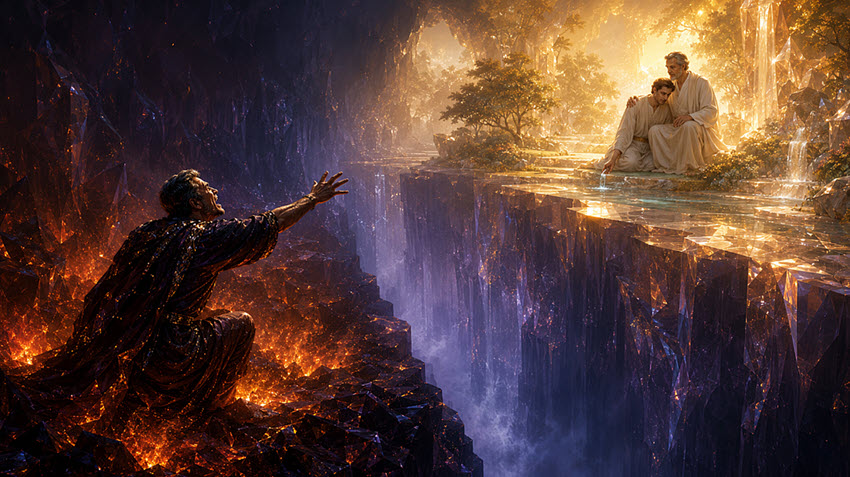
Let us begin with the story of Lazarus and the Rich Man:
„There was a certain rich man who dressed in purple and fine linen and feasted sumptuously every day. There was also a poor man named Lazarus, laid at his gate, covered with sores. He longed to satisfy his hunger with what fell from the rich man’s table; and even the dogs came and licked his sores. And it came to pass that the poor man died and was carried by the angels to Abraham’s bosom; the rich man also died and was buried. And being in Hades, in torment, he lifted up his eyes and saw Abraham from afar, and Lazarus in his bosom. And he cried out: Father Abraham, have mercy on me and send Lazarus to dip the tip of his finger in water and cool my tongue, for I am in pain in this flame. But Abraham said: Child, remember that you received your good things in your lifetime, and Lazarus likewise the bad; but now he is comforted here, and you are in pain. And besides all this, a great chasm has been fixed between us and you, so that those who wish to pass from here to you cannot, nor can anyone cross over from there to us. Then he said: I beg you, therefore, father, to send him to my father’s house. For I have five brothers—let him bear witness to them, so that they too do not come to this place of torment. Abraham said to him: They have Moses and the Prophets; let them listen to them. But he said: No, Father Abraham, but if someone from the dead goes to them, they will repent. And he said to him: If they do not listen to Moses and the Prophets, then even if someone from…” …someone rises from the dead, they will not be convinced” — Luke 16:19-31.
Let’s see how much controversy there is here:
2.1 – Is it a parable or a description of reality after death?
Some see this as a parable or story told by Christ, while others believe it describes the actual state of life after death.
2.2 – Is a person conscious after death?
The text depicts the rich man after his death: conscious, speaking, remembering his family, and suffering.
2.3 – What is Hades?
Biblical verses state that a person undergoes punishment following God’s judgment. Punishments involving so-called fire take place in Gehenna or the lake of fire. Here, however, the text speaks of Hades. The Bible describes Hades and Sheol as the place where people go after death; here, they are depicted as involving punishment by fire.
2.4 – Can one change one’s fate after death?
The text speaks of a „great chasm” that cannot be crossed, so no return to earth after death is depicted here. Yet, we have a verse suggesting that the Gospel was preached to the dead. To what end? Why?
Is The Good News Preached to The Dead?
2.5 – Can the dead return and warn the living?
The rich man asks Abraham to send the deceased Lazarus to his brothers to teach them how to live wisely. Abraham replies that they should listen to Moses and the Prophets. He does not deny that the dead could be sent.
2.6 – Does this passage contradict reincarnation?
The story of the rich man confirms that the spirit or soul does not die; it can rise and appear to the living. It also challenges the concept of reincarnation, as it depicts death, a conscious state following death, and the absence of any return to a new earthly life. The rich man cannot return to his brothers on his own initiative; instead, he asks Abraham for permission to send someone back from the dead.
To understand these various controversies, one must look at what the Creator of this world says. He knows best what happens to a person after death: do we die once, twice, or many times? Is it possible to continue living after death? Does a person feel anything? Does one even remain a human being at that stage? These are just a few of the questions involved.
I invite you to read the next article in this series, but in the meantime, dear reader, consider this thought:
„And just as it is appointed for people to die once, and after that, judgment.” — Hebrews 9:27.
Greek text: καὶ καθ’ ὅσον ἀπόκειται τοῖς ἀνθρώποις ἅπαξ ἀποθανεῖν, μετὰ δὲ τοῦτο κρίσις
Key words – Strong:
|
Greek |
Transliteration |
Strong |
Meaning |
|---|---|---|---|
| ἀπόκειται | apokeitai | G606 | It is set aside, designated, allocated, and decided upon. |
| ἀνθρώποις | anthrōpois | G444 | to people, to the individual as a human being |
| ἅπαξ | hapax | G530 | once, one time, on a single occasion |
| ἀποθανεῖν | apothanein | G599 | To die |
| μετὰ δὲ τοῦτο | meta de touto | G3326 / G5124 | and after that, then, subsequently |
| κρίσις | krisis | G2920 | court, judgment, resolution |
My Analysis:
This verse says: it is appointed for people to die once, and then comes judgment.
The word ἅπαξ / hapax / G530 is very important here, as it means „once.” The text does not speak of multiple deaths, multiple earthly lives, or a cycle of returns; it speaks of a single human death and the judgment that follows it.
The word κρίσις / krisis / G2920 signifies judgment, a decision, or a verdict. Thus, after death, a person does not pass into another incarnation but instead faces God’s verdict.
Let’s throw in a few more verses…
Responsibility for life in the body:
“For we must all be revealed before the tribunal of the Anointed One, so that each one may receive according to what he has done through the body, whether good or bad” — 2 Corinthians 5:10.
Resurrection, not reincarnation:
„Do not be amazed at this, for the hour is coming when all who are in the graves will hear His voice and come out: those who have done good, to the resurrection of life, and those who have done evil, to the resurrection of judgment” — John 5:28-29.
The appointed day of judgment:
“Because He has set a day on which He will judge the inhabited earth in righteousness by the Man whom He has appointed, giving proof to all by raising Him from the dead” — Acts 17:31.












Zapraszam do komentowania, wyrażania swojej opinii: