
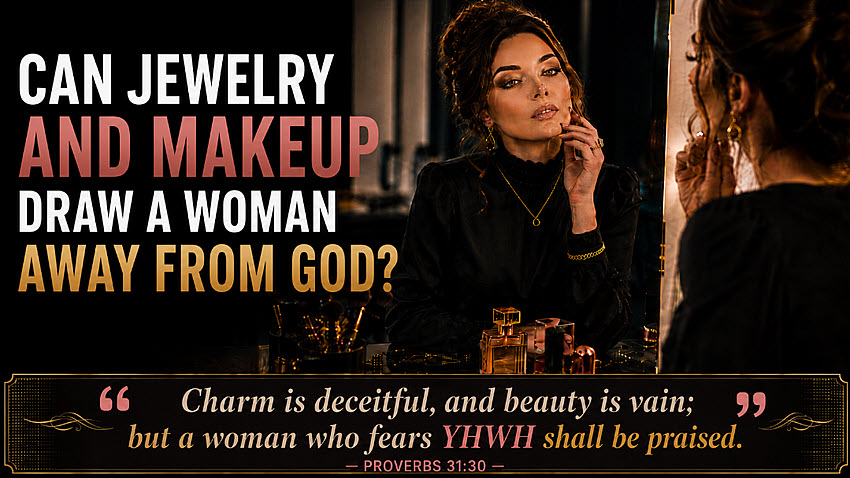
God created a beautiful and colorful world. He adorned the flowers beautifully, gave birds their colors, animals their patterns, stones their luster, and the sky its light.
Therefore, beauty itself is not the problem. The problem arises when a person uses beauty for pride, seduction, rivalry, or self-display.
The Bible does not give women rules such as „this color is allowed, that one isn’t,” or „these nails are good, those are bad.” God gives simpler and more powerful principles: purity, modesty, good judgment, feminine dignity, and a heart submitted to God.
A woman can be well-groomed, beautiful, colorful, elegant, and feminine. She need not shy away from beauty. She simply must ensure that her appearance does not say: „look at my body,” „look at my wealth,” or „look at how beautiful I am.”
What matters most is that one’s appearance aligns with a heart that truly desires to serve God.
See what God says to women and men.
1. God created a beautiful world:
„And God saw everything that He had made, and behold, it was very good” — Genesis 1:31.
Beauty is not an invention of the world. Beauty begins with God. It is He who created colors, light, shapes, scents, and harmony. Therefore, biblical modesty does not mean ugliness. It means beauty in good order.
2. Creation is full of God’s wisdom:
„How numerous are Your works, YHWH! You have made everything in wisdom; the earth is full of Your creatures” — Psalm 104:24.
God did not create a world devoid of expression. He bestowed diversity upon the flowers, the animals, the sky, the sea, and the earth. It is right to appreciate beauty, but we should remember that beauty serves wisdom, not pride.
3. God clothes the flowers beautifully:
„Consider the lilies of the field, how they grow: they neither toil nor spin. Yet I tell you that even Solomon in all his glory was not arrayed like one of them” — Matthew 6:28-29.
4. The beauty of creation surpasses royal wealth:
„Consider the lilies, how they grow: they neither toil nor spin; and I tell you, even Solomon in all his glory was not arrayed like one of them” — Luke 12:27.
The same image is repeated in the Gospel of Luke. It shows that beauty from God has no need for vanity. We are meant to be beautiful—especially spiritually.
5. God allowed beauty in service:
“You shall make holy garments for Aaron your brother, for glory and for beauty.” — Exodus 28:2.
God did not say, „the uglier, the better.” In the vestments for service, He allowed for beauty, dignity, and meticulous care. This is an important principle: beauty can be pure if it is submitted to God.
6. God used colors and noble materials:
„They shall make the ephod of gold, of blue and purple and scarlet material and fine twisted linen, the work of a skilled craftsman” — Exodus 28:6.
Blue, purple, crimson, gold, and linen were not bad in themselves. God made use of colors and beautiful materials. Therefore, a woman need not fear color; she simply must ensure that color and adornment do not become a language of pride.
7. After the fall, man began to cover his nakedness:
„Then the eyes of both of them were opened, and they realized they were naked; so they wove fig leaves together and made themselves coverings” — Genesis 3:7.
From the moment sin entered the world, shame regarding nakedness appeared. This demonstrates that the body is not meant for public display. Clothing is intended to protect dignity, not to turn the body into a spectacle.
8. God Himself gave man clothing:
„And YHWH made garments of skins for Adam and his wife, and clothed them” — Genesis 3:21.
This shows that covering the body is not a human invention but belongs to the divine order. Public nudity is not part of God’s order.
9. God does not treat nakedness lightly:
„You shall not go up by steps to My altar, lest your nakedness be exposed there” — Exodus 20:26.
This text illustrates the principle of dignity. Nakedness was not meant to be exposed. The body is not a matter of indifference; it is to be covered.
10. The garment was intended to cover the body:
„You shall make linen trousers for them to cover their nakedness; they shall reach from the hips to the thighs” — Exodus 28:42.
Here, God speaks very practically: a garment is meant to cover. This is not a matter of fashion, but a principle of dignity.
11. Nakedness can be an image of spiritual shame:
“I advise you to buy from Me white garments, so that you may clothe yourself and the shame of your nakedness may not be revealed” — Revelation 3:18.
God shows that public nudity can signify disgrace.
12. Blessed is he who keeps watch over his garments:
“Blessed is the one who stays awake and keeps his garments, so that he does not walk naked and his shame is not seen” — Revelation 16:15.
This image speaks of watchfulness, purity, and readiness. The garment reveals the state of a person before God.
13. Beauty without the fear of God is fragile:
„Charm is deceptive, and beauty is fleeting; the woman who fears YHWH—she shall be praised” — Proverbs 31:30.
Beauty fades. Fashion passes. The body changes. If someone regards these things as the most important values in life, they will be disappointed.
14. A good woman can wear beautiful clothes:
„She makes coverings for herself; linen and purple are her clothing” — Proverbs 31:22.
The woman of Proverbs 31 is not described as unkempt. She wears fine, beautiful, and high-quality clothing. This passage clearly shows that beautiful clothing is not a sin. Vanity, pride, and worthlessness are the sins.
15. Clothing is also meant to protect the home:
„She does not fear the snow for her household, for her entire household is doubly clothed” — Proverbs 31:21.
Clothing has a practical dimension. A wise woman ensures the warmth, safety, order, and dignity of the home. It is not just about appearance; it is about care, foresight, and responsibility.
16. Dignity can be like clothing:
„Strength and dignity are her clothing, and she laughs at the days to come” — Proverbs 31:25.
A woman’s most beautiful attire is not merely fabric; it is strength, purity, dignity, and serenity. Such a woman need not shout through her appearance, for her life possesses beauty in the eyes of God.
17. Purity and joy are not opposed to each other:
„Let your garments always be white, and let not oil be lacking on your head” — Ecclesiastes 9:8.
The whiteness of the garments signifies purity, while the oil represents joy and grooming. The Bible does not teach neglect; it teaches purity and simple beauty devoid of impure intent.
18. God clothes with salvation:
“I will greatly rejoice in YHWH; my soul will exult in my God, for he has clothed me with the garments of salvation and covered me with the robe of righteousness” — Isaiah 61:10.
19. Filthy garments signify guilt; clean ones, purification:
„Joshua was dressed in filthy garments and stood before the messenger. And he answered and said to those standing before him: 'Remove the filthy garments from him'” — Zechariah 3:3-4.
The garment here reveals a spiritual state. The filth is removed, and the person receives a clean covering.
20. The bride has clean linen:
„She was granted to be clothed in shining, clean linen; for the linen represents the righteous acts of the saints” — Revelation 19:8.
The Bride is not depicted amidst filth or chaos. She is clothed in clean linen. It is a spiritual image, yet a very powerful one: the outward appearance is meant to reflect a pure life.
21. White robes speak of purification:
“These are the ones who come out of the great tribulation; they have washed their robes and made them white in the blood of the Lamb” — Revelation 7:14.
A clean robe is a sign of the purification of the spirit here.
22. A woman should dress modestly and sensibly:
“Likewise, women should adorn themselves in modest apparel, with propriety and sobriety—not with braided hair and gold, or pearls, or costly clothing” — 1 Timothy 2:9.
Here, we are forbidden from using our appearance to project pride, wealth, or vanity.
Paul does not say that a woman must be ugly, drab, unkempt, or devoid of adornment. He says that a woman who serves God should dress in an orderly, modest, and sensible manner. The point of the verse is this: do not base your worth on hairstyles, gold, pearls, or expensive clothing. Do not let your appearance scream wealth, sensuality, or a desire for admiration.
In the very next verse—1 Timothy 2:10—Paul immediately reveals what should constitute a woman’s true adornment. See below:
23. Good deeds are the most beautiful adornment:
“But with good deeds, as is proper for women who profess reverence for God” — 1 Timothy 2:10.
Paul points to the true adornment of a woman: good deeds. Clothing may be attractive, but it cannot replace integrity of life, a pure spirit, or the beauty of one’s personality. A woman may be beautiful, well-groomed, and elegant; yet her beauty is meant to be surrendered to God, not used for vanity, sedentation, or the display of status.
24. Adornment must not be merely external:
“Do not let your adornment be merely outward—braiding the hair, wearing gold jewelry, or putting on fine clothes” — 1 Peter 3:3.
Peter does not forbid every hairstyle, every piece of gold, or every garment—for then he would also have to forbid the wearing of clothes. The point is simple: do not base your worth on outward adornment.
25. God values a gentle and quiet spirit:
“But the hidden person of the heart, in the incorruptible quality of a mild and quiet spirit, which is of great value in the eyes of God” — 1 Peter 3:4.
This is an adornment that time does not destroy. The face changes, the body changes, fashion changes. But a gentle, quiet, and pure spirit—or character—holds value in the sight of God.
26. The godly women of old adorned themselves with hope in God:
“For this is how the holy women of the past used to adorn themselves, who placed their hope in God” — 1 Peter 3:5.
The true adornment of holy women was hope in God, a gentle and quiet spirit, and good conduct.
27. Headgear indicates order:
“Every woman who prays or prophesies with her head uncovered dishonors her head” — 1 Corinthians 11:5.
Paul links a woman’s appearance to the order established before God. He does not regard the body, head, and hair with indifference. A woman who prays must remember that her appearance can also express respect or a lack of respect for God’s order.
28. A woman’s hair is not a matter of indifference:
„For if a woman does not cover herself, let her also have her hair cut off; but if it is a disgrace for a woman to have her hair cut off or shaved, let her cover herself” — 1 Corinthians 11:6.
Paul shows that a woman’s hair matters. It is a matter of feminine dignity and God’s order.
29. Nature teaches the difference between man and woman:
“Does not nature itself teach you that if a man wears long hair, it is a disgrace to him?” — 1 Corinthians 11:14.
This text illustrates the principle of distinction. God created man and woman. Appearance should not blur this distinction. Hair is one of the visible signs of this difference.
30. Long hair is a woman’s glory:
“If a woman lets her hair grow long, it is a glory to her, because her hair has been given to her instead of a covering” — 1 Corinthians 11:15.
Long hair is a woman’s glory. It is not a matter of counting centimeters, but of preserving feminine dignity and the distinction that God has inscribed in creation.
31. The Bible recognizes specific exceptions regarding long hair on men:
“All the days of his vow of separation, no razor shall pass over his head; until the days are fulfilled for which he separated himself to YHWH, he shall be holy, letting the hair of his head grow long” — Numbers 6:5.
The Nazirite vow was a special vow. This does not invalidate the principle found in 1 Corinthians 11, but it teaches us to view God’s laws wisely.
32. Samson had a special calling:
“No razor shall touch his head, because the boy will be a Nazirite to God from the womb” — Judges 13:5.
The Nazirite vow was a special vow made to God for a specific period or, in exceptional cases, from birth.
It primarily entailed three things:
• Abstaining from wine or anything derived from the grapevine. The Nazirite was to maintain a state of special sobriety and separation.
• Not cutting one’s hair. The hair served as a visible sign of the vow and of separation unto YHWH.
• Not touching the dead. The Nazirite was to avoid ritual impurity, even in the case of close family.
33. The distinction between the sexes must not be blurred:
“A woman shall not wear a man’s garment, nor shall a man put on a woman’s garment, for everyone who does so is an abomination to YHWH, your God” — Deuteronomy 22:5.
This is a very strong principle. God created woman as woman and man as man. Clothing should not deliberately undermine this distinction. A woman should look feminine, dignified, and modest.
34. There is an outfit designed for seduction:
„And there a woman comes to meet him, dressed as a harlot and wily of heart” — Proverbs 7:10.
The Bible shows that clothing can convey intentions. Not every attractive outfit is wrong, but there is clothing designed to incite lust. A woman should not use her clothing as a tool of seduction.
35. Tamar’s covering of her face was interpreted as a sign of harlotry:
„She took off her widow’s garments, covered herself with a veil, wrapped herself up, and sat at the entrance to Enaim. Judah saw her and took her for a prostitute, because she had covered her face” — Genesis 38:14-15.
This excerpt illustrates a simple point: one’s clothing and the way one presents oneself can convey a message.
36. God rebukes the haughtiness of the daughters of Zion:
„Because the daughters of Zion have become haughty, walk with outstretched necks, cast wanton glances, walk with mincing steps, and jingle the ornaments on their feet” — Isaiah 3:16.
God does not rebuke beauty itself here. He rebukes arrogance, gestures, glances, the way one walks, and the use of adornments as a language of haughtiness. A woman may be beautiful, but not haughty.
37. Excessive opulence can become a sign of decline:
„On that day the Lord will take away the finery of the anklets, the headbands, the crescent ornaments, the earrings, the armlets, and the veils” — Isaiah 3:18-19.
This passage does not condemn a woman’s beauty itself. It condemns pride, ostentation, and haughtiness. The daughters of Zion used adornments, their gaze, and their manner of walking to draw attention to themselves. Therefore, God declares that He will take away the very things they boasted about. Beauty was not the problem. The problem was the heart that used beauty against God.
38. When beauty is empty, disgrace remains:
„Instead of perfume there will be stench; instead of a sash, a rope; instead of well-groomed hair, baldness; instead of rich robes, a girding of sackcloth; instead of beauty, branding” — Isaiah 3:24.
God reveals the end of pride. The daughters of Zion trusted in their appearance, ornaments, perfumes, and rich garments. God declared that all this would be reversed: instead of perfume, there would be rot; instead of adornment, disgrace; instead of beauty, disfigurement.
39. Eye makeup appears in connection with Jezebel:
“Jezebel painted her eyes, adorned her head, and looked out the window.” — 2 Kings 9:30.
Jezebel was not evil because she used makeup on her eyes. She was evil because of rebellion, idolatry, and violence. The text shows that beautification can be a form of manipulation and pride. Therefore, one must examine people’s hearts.
40. Beautification will not hide spiritual emptiness:
„Though you clothe yourself in purple, though you deck yourself with ornaments of gold, though you enlarge your eyes with paint—in vain you beautify yourself” — Jeremiah 4:30.
God speaks to the unfaithful city using the image of a woman trying to save herself through her appearance. Outward beauty cannot mask spiritual betrayal. Clothing, jewelry, and makeup cannot mend the heart.
41. Ornaments can serve the purpose of seduction:
“You bathed, painted your eyes, and adorned yourself with ornaments” — Ezekiel 23:40.
The problem is not the object itself, but the purpose: seduction, infidelity, impurity.
42. Adornments can become an instrument of unfaithfulness:
“She went after her lovers and forgot Me,” declares YHWH. “She adorned herself with her earrings and necklaces” — Hosea 2:13.
Jewelry in itself is not the essence of the sin here. The essence is forgetting God. When adornments serve unfaithfulness, they become a testament to a fall rather than to beauty.
43. God Himself describes the beautiful adornment:
„I clothed you with an embroidered robe, gave you sandals of fine leather, girded you with linen, and covered you with silk. I adorned you with ornaments, put bracelets on your arms and a necklace around your neck” — Ezekiel 16:10-11.
In this imagery, God speaks of beautiful garments, bracelets, and a necklace. Thus, one cannot honestly say that every adornment is a sin; beauty can be a gift.
Ezekiel 16 speaks primarily of Jerusalem—yet not merely of the city as a place on a map. Jerusalem is portrayed as an image of the covenant people whom God cleansed, adorned, and made beautiful, but who subsequently became unfaithful.
God speaks to Jerusalem as He would to a woman.
First, He reveals her beginnings: abandoned, unwanted, and helpless. Then He rescues, washes, clothes, and adorns her, bestowing dignity upon her. Finally, He points out her sin: she placed her trust in her beauty, her fame, and her gifts, using them to commit spiritual unfaithfulness.
44. Beauty can come from God:
„I put a ring on your nose, earrings on your ears, and a beautiful crown on your head. You were adorned with gold and silver, and your clothing was of fine linen, silk, and embroidery” — Ezekiel 16:12-13.
God shows that beauty, fabrics, and ornaments can be a sign of giftedness. The problem arises only when a person ceases to remember who bestowed that beauty and begins to rely on themselves.
45. Beauty can be spoiled by pride:
“You trusted in your beauty and played the whore because of your fame” — Ezekiel 16:15.
God bestowed beauty, but beauty became a trap when the heart began to go astray. One cannot make beauty one’s god.
46. Rebekah received a gold ornament.
Abraham’s servant was looking for a wife for Isaac. He asked God for a sign. Rebekah showed kindness: she gave him a drink and watered his camels. When the servant saw that God was guiding the matter, he gave her a gold ornament and bracelets:
“When the camels had finished drinking, the man took a gold nose ring weighing half a shekel and two bracelets for her arms” — Genesis 24:22.
Abraham’s servant gives Rebekah a costly gift because he recognizes that she might be the woman chosen for Isaac.
In that world, such ornaments could signify:
• a lavish gift for the woman,
• a way of honoring her,
• a sign of serious intentions regarding marriage,
• a demonstration that Isaac’s family was not poor,
• the beginning of formal proceedings with Rebekah’s family.
The text does not state that Rebekah did anything wrong. The Bible does not portray this as a sin. There is no rebuke. There is no mention of Rebekah being vain. On the contrary—the entire chapter illustrates God’s guidance.
Therefore, Genesis 24:22 serves as a good example that jewelry in itself is not forbidden. The problem is not the earring itself. The issue may lie in the heart: pride, vanity, seductiveness, a desire to display wealth, or an attachment to outward appearance.
47. Rebekah’s ornaments were not condemned:
“So I took the earring and put it on her nose, and the bracelets on her hands.”—Genesis 24:47.
The story of Rebekah shows that an ornament can be part of dignity and a gift. Yet, that same object can become an expression of pride in another heart. Therefore, the most important question is: what is the spirit and the purpose?
48. Ornaments could be brought as an offering to God:
„Men and women came, all whose hearts moved them; they brought brooches, earrings, rings, and necklaces—all kinds of gold objects” — Exodus 35:22.
Ornaments could be dedicated to the service of God. This shows that gold and jewelry are not impure in themselves. What can be impure is the attachment of the heart, pride, and the use of an ornament for sin.
49. The body belongs to God:
„Do you not know that your body is a temple of the Holy Spirit within you, whom you have from God, and that you are not your own? For you were bought with a price. So glorify God in your body” — 1 Corinthians 6:19-20.
A woman’s body is not a commodity, an advertisement, or a tool to arouse desire. The body belongs to God. Therefore, clothing, hair, nails, makeup, and adornments should be worthy of a servant of God.
50. Everything is to be for the glory of God:
„So whether you eat or drink or whatever you do, do it all for the glory of God” — 1 Corinthians 10:31.
Summary:
Hair: The Bible clearly states that long hair is a woman’s glory. It does not prescribe a single hairstyle for all women, but it points the way: femininity, dignity, and order.
Nails: The Bible does not give information about painting your nails. The general rule applies: cleanly, modestly, with dignity, without vanity and without the spirit of self-disclosure.
Jewelry: The Bible does not forbid all jewelry. Rebekah received ornaments, and Ezekiel 16 portrays beauty as a gift. However, the Bible strongly warns that adornments can become instruments of pride, seduction, and unfaithfulness.
Makeup: Scripture generally depicts eye makeup in a negative light, yet it does not forbid beautification. One must examine the intention: is it a matter of subtle grooming, or a mask of vanity and seduction?
Colors: God created a colorful world. Flowers, birds, animals, stones, temple fabrics, and the sky show that God loves beauty. A godly woman need not be drab; she is meant to be spiritually pure.
God gives a woman clear guidelines. He says: be pure, modest, sensible, feminine, dignified, and free from pride.
A woman who serves God can be beautiful. She can wear nice clothes. She can enjoy color. She can care for her hair. She can look elegant. But her beauty must be submitted to God.
It is a mistake to think that holiness means ugliness and neglect. God created beautiful flowers, a beautiful sky, beautiful animals, beautiful light, and beautiful colors.
Therefore, the simplest rule is this:
Let outward beauty be a reflection of our beautiful spirit. We must ensure that physical beauty does not draw us away from God, that it does not become an idol.

















Zapraszam do komentowania, wyrażania swojej opinii: