
Table of Contents
≡
- 1. The Name: How do we know that „Jesus” is a fabricated name?
- 2. What evidence exists regarding the pronunciation of the „sh” or „s” sound in the name „Yesu” / „Yeshu”?
- 3. Yesu and satan. Why was the name „Yesu” changed, while „satan” was left as is?
- 4. Does the name „Yesu” appear in the Old Covenant?
3 – Yesu and satan. Why did they change „Yesu” but leave „satan”?
This is an interesting example, because both the Greek name Yesu and the Greek term satan contain the same sound: *s*.
And yet, in the Polish language, these two names have been treated quite differently.
*Yesu* — the Greek „s” was changed to the Polish „z” — *Jezu*.
The Greek spelling gives us:
Ἰησοῦ — *Yesu*.
In the middle of the name appears a Greek letter:
σ — sigma, which represents the sound: s.
Not „z”.
However, in the traditional Polish form of the name, the letter 'z’ appeared.
We see this in forms such as:
Jezu, Jezusa, Jezusowi. (Jesus, of Jesus, to Jesus)
So, the Greek 's’ was changed to 'z’ by someone.
s → z
As for the name: *satan* — the Greek „s” has been changed to the Polish „sz”.
Hebrew spelling:
שָׂטָן — satan
In this word, the Hebrew letter שׂ (sin) represents the sound: s. It is the same as in the name: Yesu.
The Greek text is equally unambiguous:
Σατανᾶς — Satanas.
Greek letter:
Σ — sigma also means: s.
And yet, in Polish, we do not say „satan” or „zatan,” but rather „szatan.”
In other words, in this instance, a change has taken place:
s → sz.
So, we have two different ways of treating the same Greek sound:
Yesu→ in the Polish form someone swapped: s → z
and:
satan → satan hasn’t been swapped and is still: s → sz.
If the Greek Yesu were adapted into Polish in the same way as the word satan, we would get the Polish form: Jeszu. (Yeshu)
This shows, above all, one thing:
The later Polish form „Jezus” is not evidence of the original pronunciation.
If we wish to check the original name, we must return to the Greek text.
And there we find: Ἰησοῦ — Yesu
3.1 Joseph
Let’s look at other examples in which an 's’ from the Hebrew or Greek original has been replaced by a ’z’ in the Polish form.
Hebrew: יוֹסֵף — Josef.
Greek: Ἰωσήφ — Iosef.
Polish: Józef.
Meaning:
s → s → z
The Hebrew letter ס here represents the sound s. Greek preserved it as σ—s. It was only in the Polish form that a z appeared.
Verses: Genesis 30:24; Acts 7:9.
3.2 Israel
Hebrew: יִשְׂרָאֵל — Jisrael.
Greek: Ἰσραήλ — Israel.
Polish: Izrael.
Meaning:
s → s → z
The Hebrew שׂ — sin here produces the sound s. Greek has it as σ — s. The Polish form, however, has z.
Verses: Genesis 32:28; Matthew 10:6.
3.3 Isaiah
This example is even more interesting.
Hebrew: יְשַׁעְיָהוּ — Jeszajahu.
Greek: Ἠσαΐας — Esaias.
Polish: Izajasz.
At the location in question, we see: sz → s → z.
Hebrew has the sound: sz.
Greek renders it with s, while the Polish form has z.
This demonstrates a very important point: the Greek s can correspond to an earlier Hebrew š.
Verses: Isaiah 1:1; Matthew 3:3.
3.4 Josiah
Hebrew: יֹאשִׁיָּהוּ — Joszijahu.
Greek: Ἰωσίας — Iosias.
Polish: Jozjasz.
So once again: sz → s → z
The Hebrew form has the sound sh. Greek renders it with s, whereas the Polish form features z.
Verses: 2 Kings 22:1; Matthew 1:10.
These examples show that the Greek σ = s was not rendered in Polish according to a single, consistent rule.
There are at least three scenarios:
– Greek s → Polish z:
- Ἰωσήφ — Iosef → Józef,
- Ἰσραήλ — Israel → Izrael,
- Ἠσαΐας — Esaias → Izajasz,
- Ἰωσίας — Iosias → Jozjasz,
– Greek s → Polish s:
- Σαμουήλ — Samuel → Samuel,
- Σαλωμών — Salomon → Salomon,
- Σάρρα — Sarra → Sara.
– Greek s → Polish sz:
- Σατανᾶς — satanas → szatan,
- Σίμων — Simon → Szymon.
It follows from this that the Greek „s” was not rendered consistently in Polish. Sometimes it remained „s,” sometimes it was changed to „z,” and at other times to „sz.”
Therefore, the Polish form of the name cannot serve as evidence for what sound was present in the Greek original.
Regarding the name of Christ, the Greek is unambiguous: Ἰησοῦ — *Iēsou* (where the final sigma, σ, corresponds to 's’).
Think about this, dear reader. Please note that certain groups of Bible translators decide for themselves how a given name or title should be rendered. They lack a consistent key; instead, they translate arbitrarily, according to someone’s personal whim.
We know how deceitful the world is. For centuries, those in power have destroyed nations by instilling lies in people’s minds. In this article, we have uncovered yet another deception within the realm of faith.
It turns out that certain groups arbitrarily select names and translate them based on their own subjective interpretations. Yet, it was God the Father who gave Christ His name. Can any human being—any translator—simply change that name at will?
While one might call this negligence, it is certainly no accident. To suggest otherwise would be to dismiss these translators as mere fools or ignoramuses.
Given the inherent dishonesty of the world, it is safe to conclude that this is no coincidence; it is a form of controlled chaos. The translators must have known what they were doing.
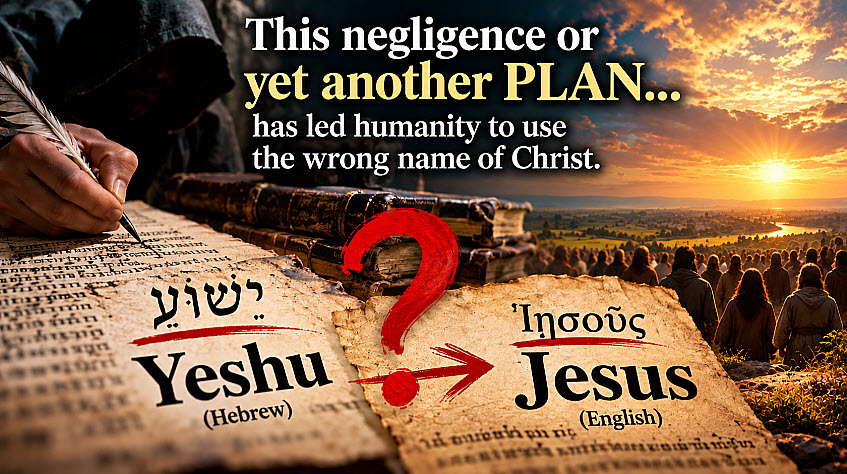
This negligence—or perhaps another calculated PLAN—has led humanity to use an incorrect name for Christ.
Truly, one must verify and examine everything.
It is the same conclusion that can be drawn in the English form of the name of Christ ( ‘Yesu’ to ‘Jesus’. ’ Jesus’ is a falsified name of Christ), and all the other languages and forms where this name has been falsified.
In the English form, they kept the Greek s, but added another s at the end, which changes the pronunciation and meaning of the name.
The name in English should be written as Yeshu/Yesu.
Yes, it is different to the original Greek Ἰησοῦ — *Iēsou* , but it must be written this way in order to keep the pronunciation of the name consistent with the Greek form.
The goal in correctly translating the name of Christ to any other language, is to write it in such a way where the pronunciation can be the same as in the Greek original version.


















Zapraszam do komentowania, wyrażania swojej opinii: